A pocket-sized spectrum analyzer turns interference from a mystery into a measurement
Interference is the most misdiagnosed fault in live sound. When a wireless microphone channel crackles, drops or burps, crews reach for new cables, new batteries and new antennas before anyone has answered the only question that matters: what is actually occupying that frequency? This article gives you a repeatable workflow - identify the sound, find the source, measure the spectrum, then apply the right fix.
Everything recommended here uses hardware documented on this site, including the U.Discover portable spectrum analyzer, and RF ranges verified from official regulatory sources (CEPT and FCC). No third-party products are referenced.
What Does Interference Actually Sound Like?
First, separate the three sounds crews commonly lump together as "interference", because they have different causes and different fixes.
A steady hiss or white noise that appears when the transmitter turns off is simply an open receiver - the squelch gate admitting whatever the antenna hears. A periodic digital buzz or harsh truncation, often in bursts, usually means a digital device is sharing the channel. A clean drop to silence followed by recovery is classic multipath cancellation or a genuine RF hit from a stronger carrier.
The distinction matters because the fixes do not overlap: an open-receiver hiss is a gain and squelch setting, digital co-channel buzz is a frequency problem, and positional dropout is an antenna problem. Our guide to wireless microphones and walls covers the third case in depth.
Where Does RF Interference Come From?
Three families, roughly in order of how often they bite:
Other licensed users. In most regions the UHF spectrum a professional wireless microphone occupies is shared with broadcast television and other programme making and special events (PMSE) users. When a broadcaster or another production powers up nearby, your quiet slot stops being quiet.
Unlicensed digital devices. Any digital transmitter parked on your frequency - deliberately or as a spur - produces the periodic truncation sound described above. This is why the 2.4 GHz band, shared with Wi-Fi and Bluetooth, behaves differently from UHF; we compare the two bands in UHF vs 2.4 GHz for live sound.
Your own equipment. Two of your own transmitters mixing in a receiver front end can produce intermodulation products that land on a third channel. That fault deserves its own article: see intermodulation planning for multi-channel systems.
How Do You Find the Clean Spectrum Before the Show?
Walk the venue with a scanner before a single receiver is switched on. A dedicated analyzer beats a receiver scan because it shows every occupant of the band, not just the ones your own hardware can tune to.
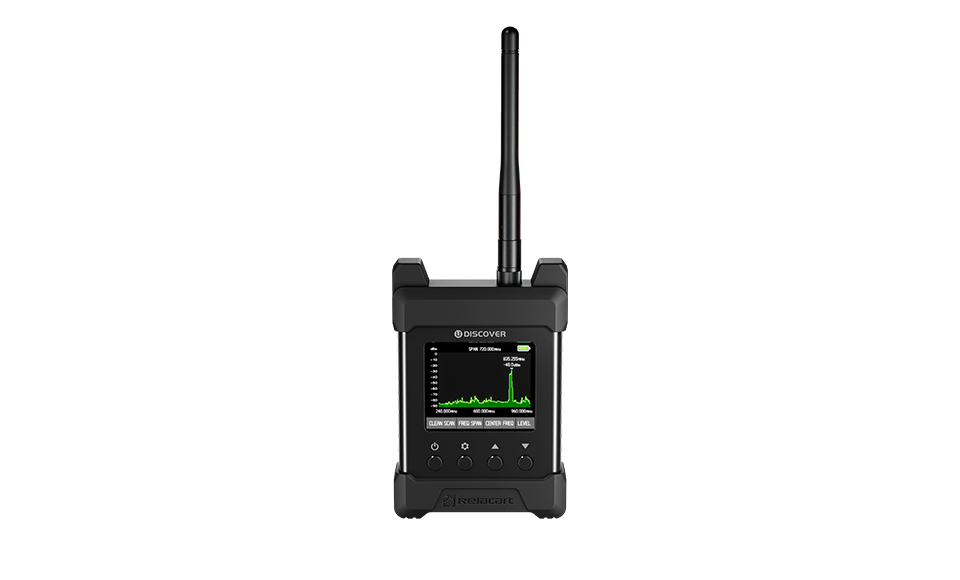
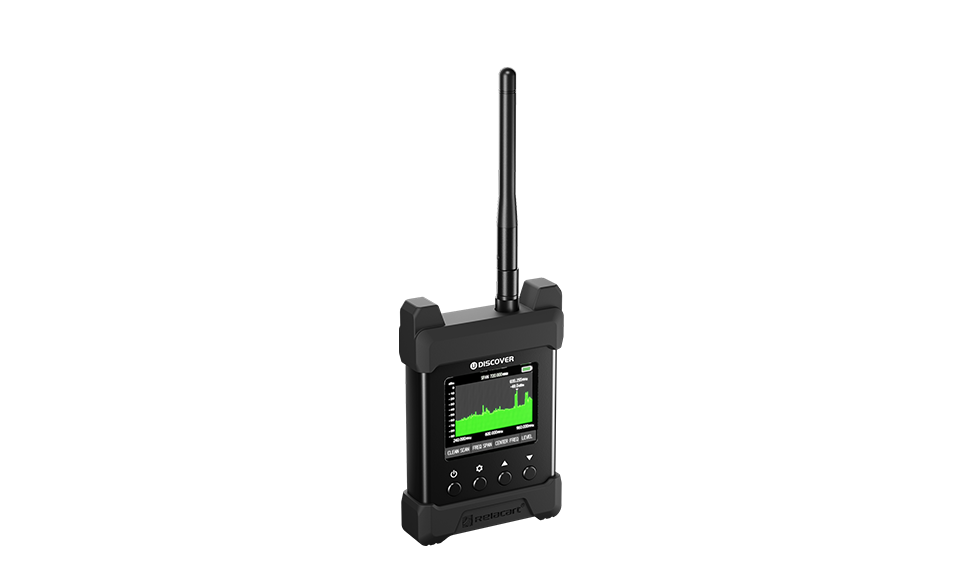
The U.Discover fits in a jacket pocket (204 mm tall with antenna, 150 g) and detects signals from 240 to 960 MHz in 1 MHz steps. Its 90 dB dynamic range and amplitude display from +10 down to -110 dBm are enough to rank candidate frequencies by how much noise floor each carries. It charges over standard USB Type-C (5 V) from its built-in 3.7 V lithium cell, so it does not compete with the show kit for outlets.
The output of this walk is a shortlist, not a plan: three to five candidate windows where the noise floor is low across the whole venue, including the stage, the control position and the lobby the audience will fill.
Which Frequencies Are Legal in Your Region?
The scan tells you what is quiet; the regulator tells you what is legal. Both answers are needed before a frequency plan is written, and they differ by country.
In the European CEPT region, 470-694 MHz is the core shared band for professional wireless microphones, and 863-865 MHz is available licence-exempt at typically 10 mW. In the United States, FCC rules permit unlicensed wireless microphones at 50 mW EIRP within 470-608 MHz and at 20 mW EIRP in the 614-616 MHz and 657-663 MHz gaps; licensed operation under Part 74 adds priority protections. Other regions differ - always confirm with your national regulator before tuning, and never treat a frequency as legal simply because it is quiet.
Fix One: Rebuild the Frequency Plan, Not the Room
Once the candidate windows are known, assign channels with two rules. Keep carriers far enough apart that neighbouring channels cannot interfere with each other (for FM systems with roughly 45 kHz deviation, several hundred kilohertz between adjacent slots is the common planning baseline), and leave every intermodulation product outside every carrier - the full arithmetic is in the intermodulation article.
Tuning range is what makes a rebuilt plan cheap instead of expensive. A wideband receiver such as the UR-2Q carries a 130 MHz tuning band across a 521.25-936.85 MHz hardware range (region-dependent), so a plan that must dodge a newly appeared broadcaster can often be re-slotted with software, not with purchases.
Fix Two: Make the Antenna Feed Deliberate
Interference severity depends on signal levels at the receiver front end - and the antenna tree controls those levels. A receiver fed by a distant omni antenna through long coax hears more of everything: the show signal, but also every interferer in the band.
Two upgrades change the arithmetic. A directional panel antenna such as the R-20U (600-900 MHz, 7 dBi, 80-degree horizontal beam) accepts the stage signal while discriminating against interferers off to the sides. Where the run is long, the active R-32AU adds an adjustable 0-15 dB amplifier with noise below 0.45 dB and an output third-order intercept point above 38 dBm - headroom that keeps strong out-of-band signals from compressing the front end and inventing intermodulation products of their own. Feeding multiple receivers cleanly is the job of the R-14D active distribution system: 0 dB (plus or minus 1 dB) per port, 500-950 MHz. The full loss arithmetic is in our antenna distribution guide.
Fix Three: Close the Open Receiver
The steady-hiss fault is not interference at all - it is the squelch doing its job badly. Set the RF gain so the wanted transmitter sits comfortably above the local noise floor, then raise the squelch threshold to just above that floor. A receiver that mutes cleanly on transmitter-off, rather than hissing, will also mute cleanly when a distant interferer sneaks in at low level - which is most of them.
Avoid the temptation to crank squelch to maximum: too high a threshold truncates quiet consonants at the edge of coverage. Set it at the show, with the show gain structure, not in the warehouse.
Symptom to action map
| Symptom | Likely cause | First action |
|---|
| Steady hiss when transmitter is off | Open receiver, squelch set below noise floor | Re-set RF gain and squelch threshold at show conditions |
| Periodic digital buzz in bursts | Digital device co-channel or adjacent | Re-scan with an analyzer, re-slot the frequency plan |
| Drop to silence at fixed stage positions | Multipath cancellation, not interference | Move or re-aim antennas; see the walls guide |
| Crackle only when many channels are live | Self-generated intermodulation | Re-plan spacing; check the intermodulation article |
| Sudden strong hit during the show | Another PMSE or broadcast user powered up | Switch the affected channels to a scanned backup window |
What Should You Do Before Every Multi-Channel Show?
- Scan the venue the day before, at the hours the event will actually run
- Shortlist candidate windows and verify each against your national regulator's rules
- Write the frequency plan down, including which backup slots belong to which receivers
- Keep one or two clean backup slots reserved and unused
- Walk the stage with every system live during rehearsal - not just the channels being rehearsed