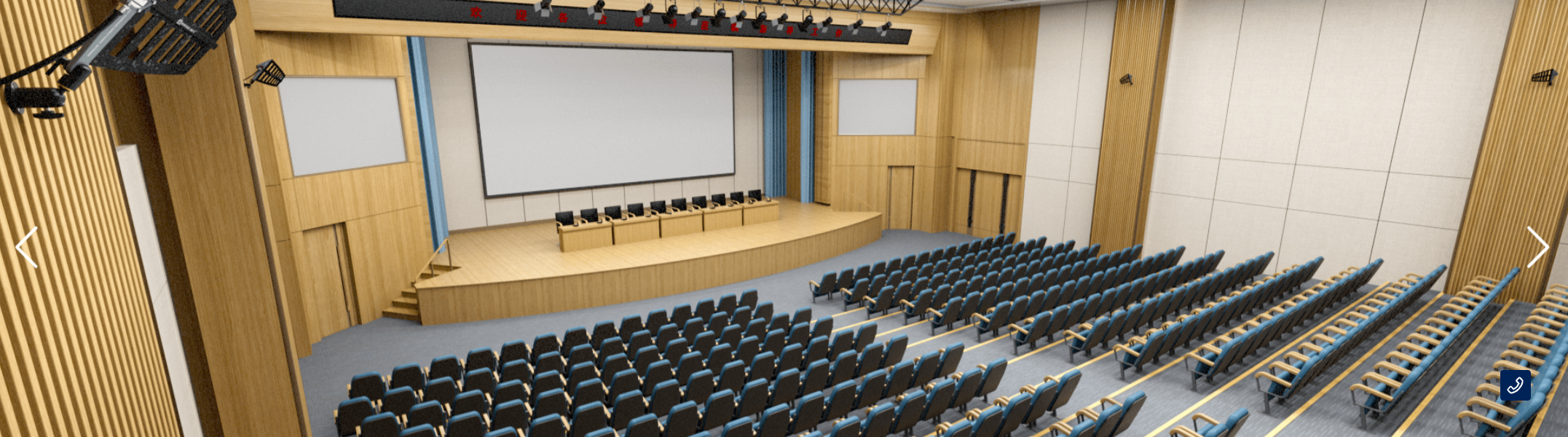
Multi-channel wireless coverage in a conference hall (product image: relacart.com)
A two-channel wireless system needs no RF infrastructure: two receivers, two antennas, done. A sixteen-channel system built the same way turns the equipment rack into an antenna farm — a wall of rear-panel whips that interfere with each other, see the same signal at different levels and phases, and make frequency coordination nearly impossible. Antenna distribution fixes this by letting many receivers share one pair of properly placed antennas.
The short version: use a passive divider for two receivers at short range, an active rack-mount distributor for anything larger, aim directional antennas where the talkers are and omnidirectional panels where they roam, inject DC down the coax so the antennas power themselves, and scan the spectrum with a handheld analyser before locking the plan. The sections below make each step concrete with Relacart’s RF distribution line.
Why one antenna per receiver stops scaling
Every receiver tuned to the same band wants the same signals. When each has its own antenna, the antennas see those signals at slightly different levels and phases, receivers wander into each other’s capture range, and the intermodulation margin you carefully planned on paper quietly disappears. Rack density makes it worse: half-wave whips a few centimetres apart couple strongly to each other.
Distribution replaces all of that with one signal chain: a pair of antennas, amplification where needed, and a splitter that feeds every receiver the same clean signal at the same level. Intermodulation performance stops depending on which receiver sits where, and antenna placement becomes a single decision instead of twelve.
Passive divider or active distribution?
A passive divider is the minimal tool: no power supply, nothing to fail, small enough to tape behind a rack. Relacart’s R-12S splits one RF input into two outputs — or, flipped, combines two antennas into one feed — with only about 3.5 dB of insertion loss across 400–1000 MHz and better than 20 dB of port isolation. It even passes DC up to +50 V at 1.5 A, so bias can reach an in-line amplifier without extra wiring. At roughly 35 grams, it is the piece that lives in the work case.
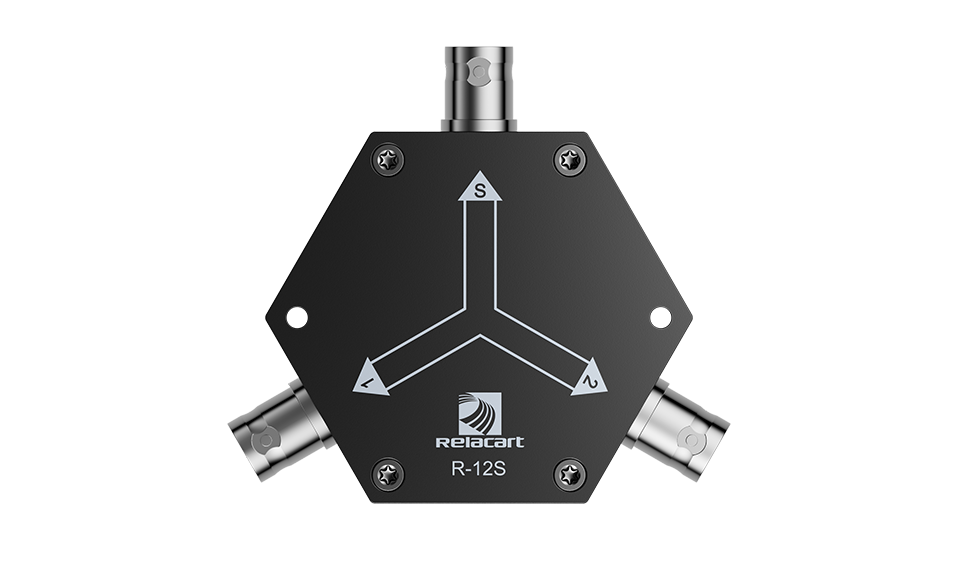
R-12S passive antenna divider / collector (product image: relacart.com)
Beyond two receivers, splitting loss starts eating the link budget, and that is when an active distributor earns its rack space. The R-14D is a dual-path, one-in-four distribution system for 470–960 MHz with 0 dB ±3 dB typical gain — the splitter loss is amplified straight back — and it powers up to four antennas from its inputs at up to 150 mA each on DC 12 V, centre-positive. One 1U chassis therefore supports two to four wireless receivers of Relacart or other brands.
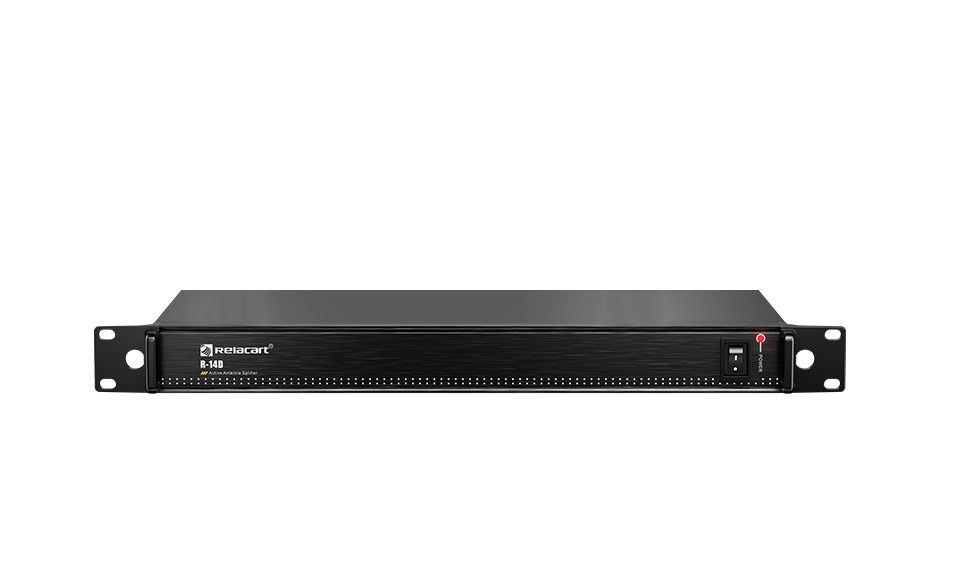
R-14D active antenna distribution system (product image: relacart.com)
Table 1 — Passive divider versus active distributor
| R-12S (passive) | R-14D (active) |
|---|
| Frequency range | 400–1000 MHz | 470–960 MHz |
| Paths | 1-in-2 out, or 2-in-1 combined | Dual-path, 1-in-4 |
| Gain | −3.5 dB ±1 dB insertion loss | 0 dB ±3 dB typical |
| Antenna powering | Passes DC up to +50 V / 1.5 A | Up to 150 mA per input, DC 12 V (4 groups) |
| Form factor | 65 × 50 × 20 mm, about 35 g | 1U rack, 410 × 43 × 206 mm, about 2.5 kg |
For mid-size rigs, the AS-24 fills the same role as the R-14D across a 470–900 MHz window with 32 MHz of bandwidth and ultra-low intermodulation distortion — the specification that matters most when many transmitters share the room.
Choosing the antennas
Distribution only pays off if the antennas themselves are placed deliberately. Directional antennas concentrate pickup where the speakers actually are; omnidirectional panels cover rooms where talkers move.
The R-32AU wideband directional antenna covers 470–950 MHz with a cardioid pattern and at least 6.5 dB of antenna gain, plus a switchable 0–15 dB in-line amplifier whose noise figure stays below 0.45 dB. It mounts on a microphone stand, hangs from the ceiling, or fixes to a wall on its integrated swivel bracket — three placements that cover most venues.
Where coverage must be even rather than aimed, the R-20U omnidirectional panel antenna serves 600–900 MHz UHF systems from a UV-resistant ABS enclosure built for permanent installation — including compliance with the new telecom regulations of overseas markets, which is often the binding constraint on international productions.
For wideband work, the R-43W rod antenna spans 400–950 MHz and 2000–2500 MHz at 9 dB of gain with a standing-wave ratio of no more than 2, terminating in a type-N male connector — one antenna that follows the system through UHF and 2.4 GHz digital gear alike.
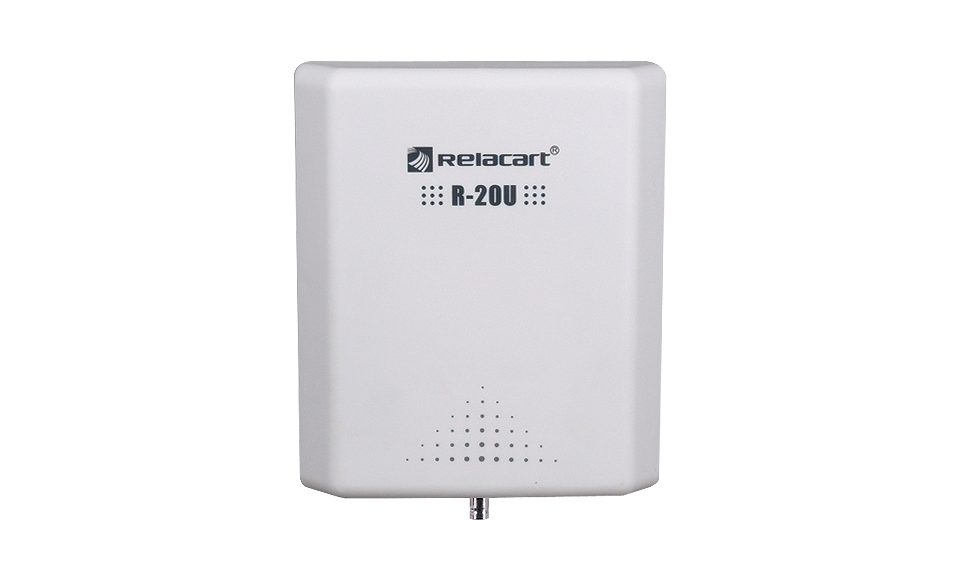
R-20U omnidirectional panel antenna (product image: relacart.com)
Power and cabling
Remote antennas need power, and the cleanest way to send it is down the coax itself. The R-20P in-line power injector feeds DC 8 V at 300 mA into the antenna line while attenuating in-band signals by less than 1.5 dB between 200 MHz and 1 GHz — an aluminium-alloy unit that runs from any 12 V/1 A adapter and tolerates −25 to 50 °C. Between its BNC ports and the R-14D’s per-input 150 mA budget, most installations never need a separate power run to an antenna position.
Keep coax runs short anyway. Every metre of cable costs decibels that no amplifier politely returns; mount the distributor near the receivers and extend the antennas, not the other way around.
Scan the room before you commit
Frequency planning starts with knowing what the room already contains. The U.Discover handheld spectrum controller sweeps 240–960 MHz and shows live occupancy on a high-contrast display, with a noise floor around −75 dBm at 0.5 GHz — small enough for a jacket pocket, fast enough to run between soundcheck and doors. Walking the stage and the rack position with it turns antenna placement from folklore into measurement.
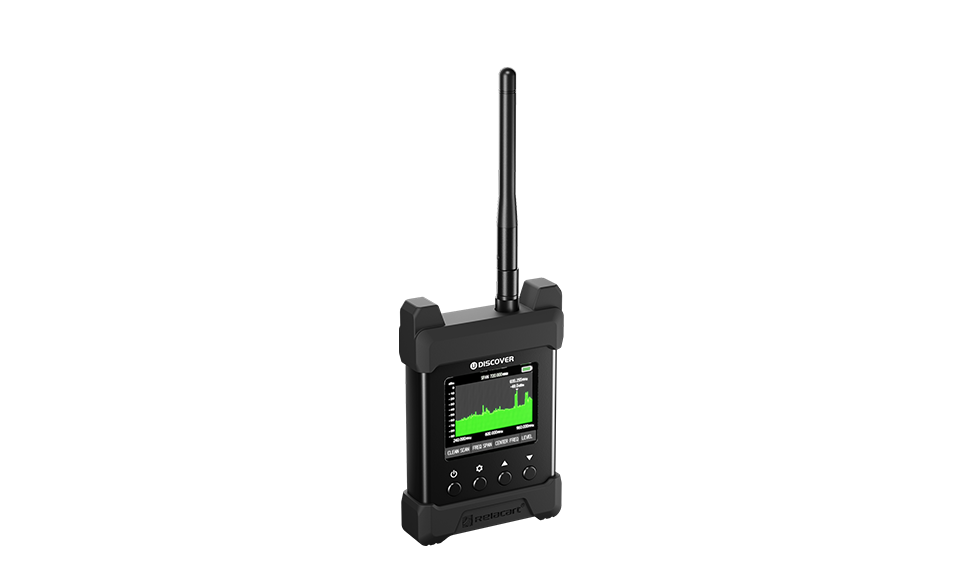
U.Discover portable spectrum management controller (product image: relacart.com)
The workflow is short: scan, pick the quiet windows, coordinate intermodulation-free frequency sets, then place the antennas so the strongest signals arrive where the receivers listen. Distribution hardware makes that last step serve every receiver at once.
Frequently asked questions
When do I need an antenna distribution system?
Once more than about four receivers share one band. Below that, individual antennas are manageable; above it, a distributor such as the R-14D lets every receiver share one antenna pair, which improves intermodulation behaviour and turns placement into a single decision.
What is the difference between a passive divider and an active distributor?
A passive divider like the R-12S needs no power and costs about 3.5 dB of signal, which suits two receivers at short range. An active distributor like the R-14D makes up the splitting loss with 0 dB typical gain and also powers the antennas — the right tool for rack-mounted multi-channel systems.
Where should I point a directional antenna?
At the area where the transmitters actually work. The cardioid R-32AU concentrates pickup in one direction with at least 6.5 dB of gain and can be stand-, ceiling- or wall-mounted; use omnidirectional panels such as the R-20U when talkers move around the whole room.
Do remote antennas need their own power supply?
Often not — power can travel down the coax. The R-20P injector delivers DC 8 V at 300 mA over the antenna cable with less than 1.5 dB of in-band loss, and the R-14D supplies up to 150 mA per antenna input, so most installations avoid a separate power run.
How do I find clean frequencies before an event?
Scan first. The U.Discover handheld controller sweeps 240–960 MHz and displays live occupancy with a noise floor near −75 dBm at 0.5 GHz, so you can pick quiet windows and coordinate around whatever the venue is already running.