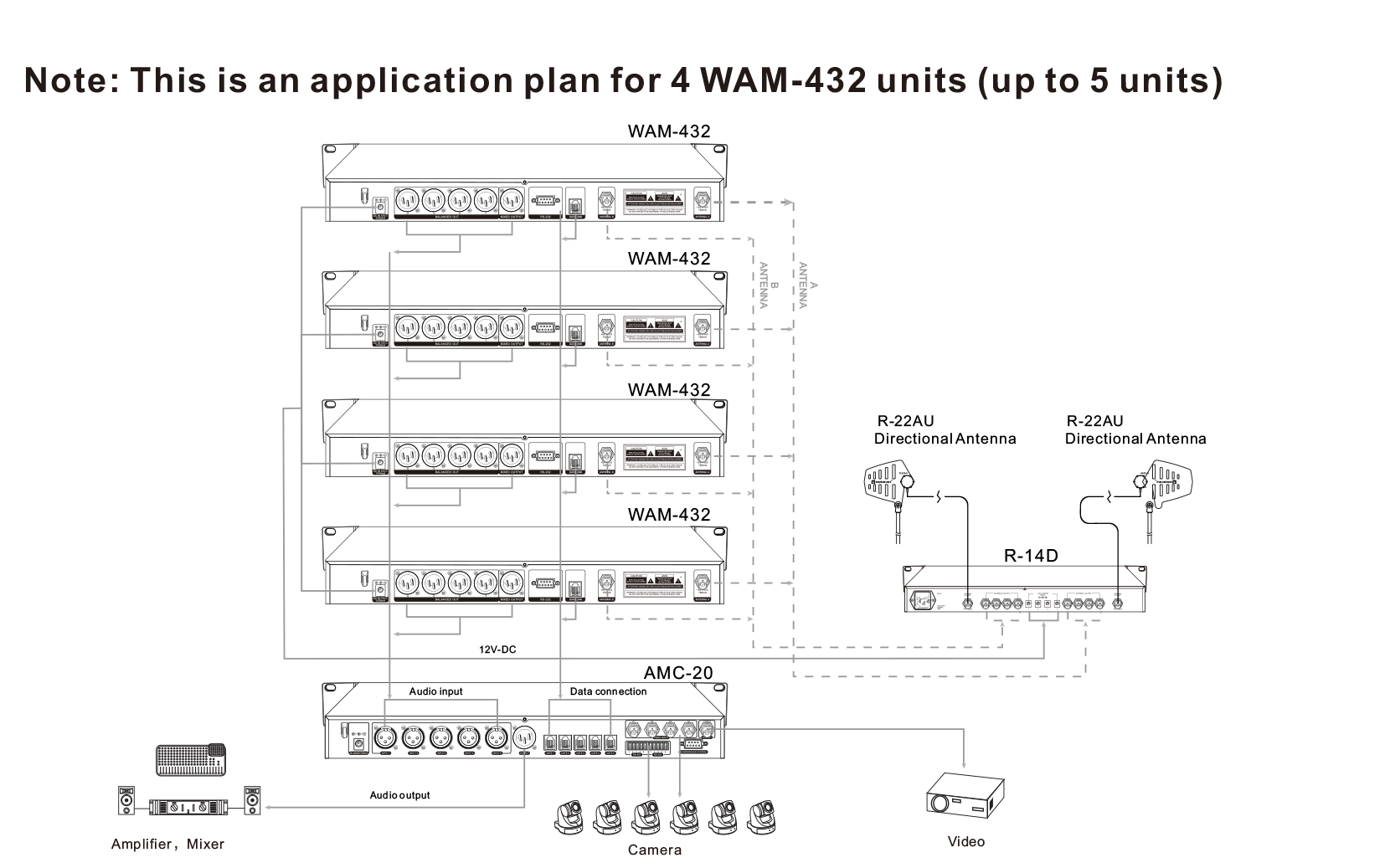
A four-unit mixer installation with shared directional antennas: the kind of density where intermodulation planning stops being optional
Buy enough receivers and the limit on your channel count stops being money - it becomes arithmetic. Every pair of transmitters you switch on creates new, invisible signals called intermodulation products. Below roughly eight channels a decent frequency plan can simply avoid them. Above that, the products multiply faster than the channels, and planning them out is the difference between a clean show and a crackling one.
This article explains the physics without equations you cannot use, gives the channel-pair arithmetic that tells you when to worry, and lists the hardware decisions - tuning range, front-end linearity, antenna distribution - that make a large plan stable. It complements our 8-channel rack guide, which covers the physical side of density.
What Is Intermodulation, Physically?
Any two strong signals meeting in a non-linear device - a transmitter output stage, a receiver front end, even a corroded connector - produce new frequencies at the sums and differences of the originals and their multiples. The family that matters for wireless microphones is the third-order pair: 2f1 minus f2, and 2f2 minus f1.
Here is why that pair is uniquely nasty. If two carriers sit 400 kHz apart, 2f1 - f2 lands 400 kHz below the lower carrier and 2f2 - f1 lands 400 kHz above the upper one - inside the very band you are using. Sum and difference products (f1 + f2) land far outside the UHF band and are filtered away harmlessly. Third-order products are the only ones that land back inside your operating window, which is why frequency planners track them obsessively.
The products are real signals. When a product lands on a third receiver's carrier, that receiver hears it as a weak, wavering version of somebody else's programme - the classic "foreign audio ghosting" complaint on busy multi-channel shows.
Why Do the Products Only Bite at Eight Channels?
Because the count of transmitter pairs compounds. Intermodulation between two carriers requires, at minimum, a pair - so the number of candidate products grows with the number of pairs, and pairs grow quadratically.
Four active channels make 6 possible pairs. Eight channels make 28. Twelve channels make 66. The channels doubled from 4 to 8; the pairs more than quadrupled. And each pair throws its third-order products onto whatever frequencies sit nearby, so the probability that at least one product lands on one of your carriers climbs steeply with channel count.
This is why a four-channel meeting room can be tuned by ear in ten minutes, while a twelve-channel festival stage needs a plan computed before the first transmitter is switched on. Our 4 vs 8 channel comparison tells the same story from the rack side.
Transmitter pairs by channel count
| Active channels | Transmitter pairs | Planning style that works |
|---|
| 2 | 1 | By ear, any spacing above 300-400 kHz |
| 4 | 6 | Spacing rules, checked once |
| 8 | 28 | Computed frequency set, written down |
| 12 | 66 | Software coordination plus on-site verification |
| 16+ | 120 | Full coordination workflow with reserved re-tune slots |
How Much Spacing Does a Plan Actually Need?
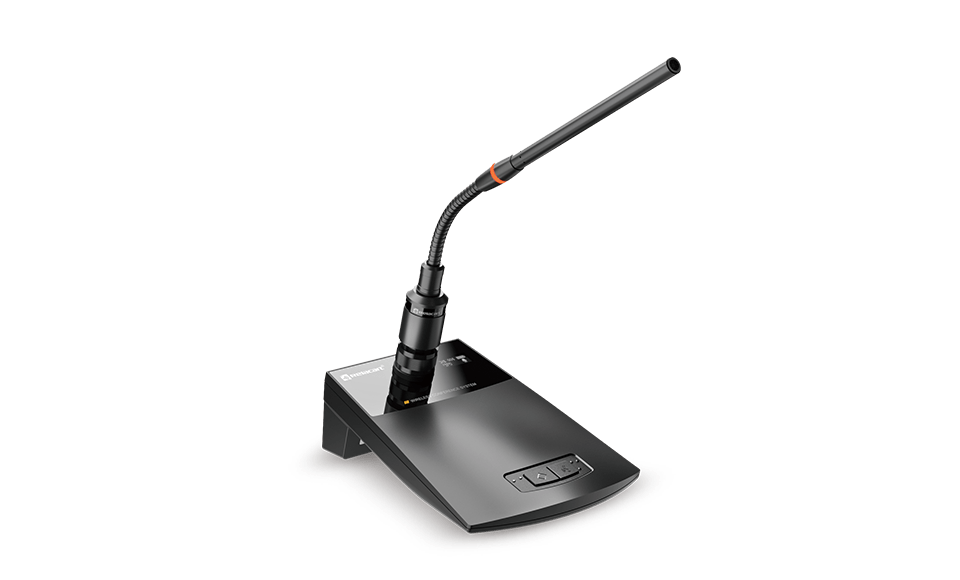
Two numbers set the baseline. First, deviation: transmitters on this site work at around 45 kHz maximum deviation (the UH-222 handheld and WDC-903 conference units are specified at plus or minus 45 kHz; the PM-320 stereo in-ear link at plus or minus 48 to 50 kHz), so adjacent carriers need several hundred kilohertz of separation to be received cleanly.
Second, the products. A computed frequency set places carriers so that every 2f1 - f2 and 2f2 - f1 product lands in a guard window rather than on a carrier. Coordination software does this automatically; done by hand, the practical recipe is to lay carriers in non-uniform patterns rather than an even ladder, because an even ladder is exactly the geometry that stacks products onto carriers.
A wide tuning window is what buys the room to do this. The UR-2Q and HR-32D carry 130 MHz tuning bands (region-dependent) inside a 521.25-936.85 MHz range - enough headroom to place twelve carriers plus their guard windows in most regulatory environments. A 64 MHz window (as on the UR-280, region-dependent) comfortably serves four to eight.
What Keeps the Front End Linear?
Intermodulation is created inside non-linear stages, so hardware linearity is a defence, not a marketing line. The specification to look for on active antennas is the output third-order intercept point (OIP3): higher is better, because it marks how much signal the device can pass before it starts manufacturing products.
The R-32AU active directional antenna specifies OIP3 above 38 dBm with amplifier noise below 0.45 dB and an adjustable 0-15 dB gain - a front end that stays linear under festival-strength signals. Its counterpart, the R-14D four-channel distribution system, passes 0 dB (plus or minus 1 dB) per port so the receiver front ends are neither starved nor overfed.
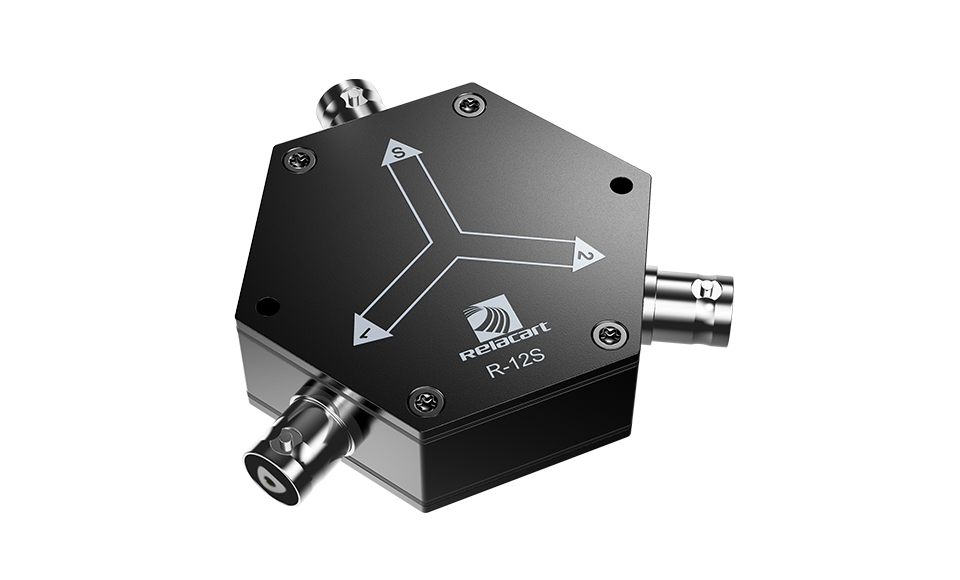
Passive hardware can contribute too: the R-12S divider has no active parts at all, so it cannot create products - its cost is the 3.5 dB of insertion loss per split instead. The choice between passive loss and active linearity at each rack is exactly the trade covered in the antenna distribution guide.
How Do You Verify a Plan on Site?
A computed plan is a hypothesis; the venue has the final word. The verification loop takes minutes with a pocket analyzer:
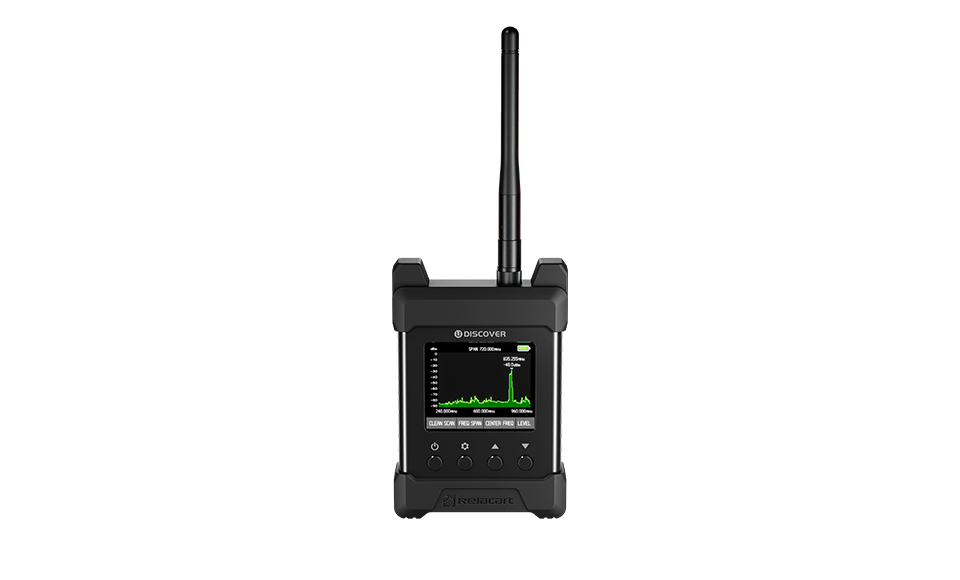
Scan the venue for occupants (the U.Discover covers 240-960 MHz in 1 MHz steps with a 90 dB dynamic range), cross out any planned carrier that now collides with a real signal, then switch on the full fleet and listen to each channel with its transmitter muted and active in turn. A channel that sounds clean with all transmitters on - not just its own - is verified. Channels that fail get re-slotted from the reserved backup windows before doors, not during the support act.
Keep one or two frequencies reserved and unused in every plan. The cost of a reserved slot is zero; the cost of re-planning during a show is everything.
What Should a Written Plan Contain?
- The computed frequency set, including every product location, not just the carriers
- Which receiver and transmitter carries which slot, by serial number for rental fleets
- One or two reserved backup slots per band, unused
- The venue scan results and date, so the next crew inherits the evidence
- The re-tune procedure: who is allowed to change a slot mid-show, and to which alternatives