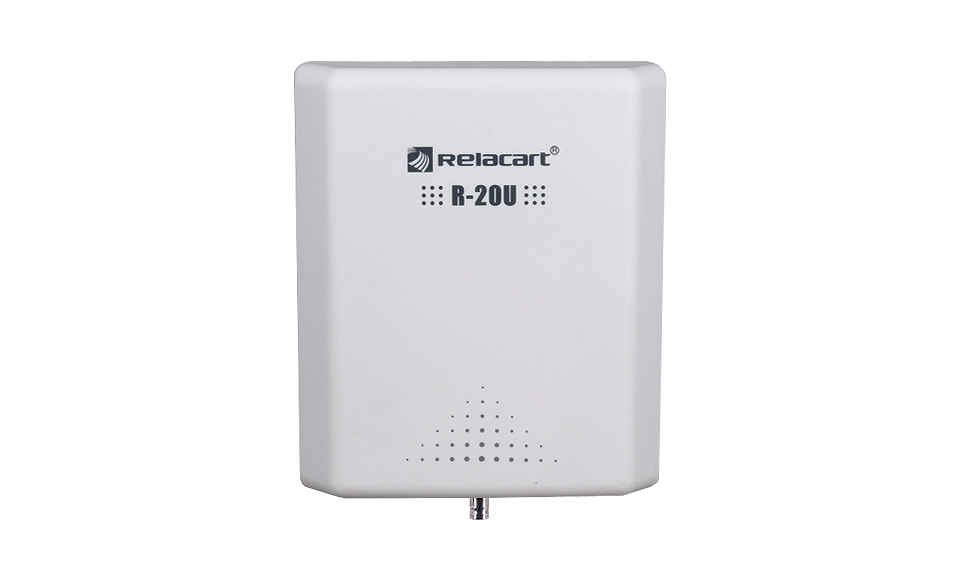
The R-20U panel antenna: 7 dBi of gain aimed straight through the difficult part of the building
A wireless microphone can work through walls - within limits that are entirely predictable once you stop thinking of a wall as "blocking" and start counting the decibels it charges. Every material between transmitter and receiver subtracts from a link budget that was never generous to begin with.
This field guide gives you the working numbers: typical attenuation by material, why the dropout always happens at the same spot on stage, and four fixes in the order a professional would try them. All antenna and receiver specifications are quoted from the official product pages on this site.
The Short Answer
Yes - one or two light partitions rarely stop a modern UHF system. A concrete stairwell shaft will. The useful question is not "can it?" but "how much of my link budget does this building spend, and what is left for the last ten metres?"
A useful mental model: distance and walls both draw from the same budget. A receiver rated for roughly 100 metres of open-space range (the figure on the UR-280 specification page) is not rated for 100 metres through a factory. Count walls first, metres second.
What a Wall Actually Does to a UHF Signal
Walls do two things at once: they absorb energy (turning it into heat inside the material) and they reflect it (creating the multipath echoes discussed below). The absorption part is what the table below quantifies.
The values are typical field-of-practice figures for the UHF range at the frequencies wireless microphones use - treat them as planning estimates, not guarantees, because real construction varies enormously. A 200 mm concrete block with rebar is not the same animal as decorative concrete cladding, and moisture in the wall changes everything.
Two walls of 12 dB each remove more than 90 percent of the available power. That is why the phrase "it works through two walls" is not a specification - it is a property of one particular building, one particular antenna height and one particular Tuesday.
Typical UHF attenuation by material (planning estimates)
| Material | Typical attenuation | Field note |
|---|
| Drywall / gypsum partition | 3-5 dB | barely noticeable on a fresh link budget |
| Hollow-core wooden door | 3-4 dB | open or closed barely matters |
| Solid-core door | 5-8 dB | two of them in series start to bite |
| Single brick wall | 8-12 dB | historic buildings with damp walls cost more |
| Concrete block (200 mm) | 10-15 dB | rebar density swings this a lot |
| Reinforced concrete | 15-30 dB | stairwell and lift shafts: plan around, not through |
| Plain glass | 2-4 dB | the friendly exception in most buildings |
| Low-E coated glass | 20+ dB | the metallised coating, not the glass, does the blocking |
Why Do Dropouts Happen at the Same Spot Every Show?
Because the spot is innocent - the room is guilty. Reflected signal copies from walls, floor and ceiling arrive a fraction of a wavelength apart and cancel the direct signal at fixed points in the room. Move the performer, the cancellation points stay put, so the same stage position drops out at every show: classic multipath.
The engineering answer is true diversity reception: two antennas, spaced apart, with the receiver choosing or combining whichever feed is clean at each moment. The HR-32D receives in true diversity mode for exactly this reason - the two antennas almost never share the same cancellation point. Our true diversity field guide shows the difference on three demanding deployments.
Can You Fix It by Moving the Antennas Instead of the Receiver?
The cheapest fix is repositioning, and it is genuinely a fix, not a workaround. Receivers such as the UR-280 and HR-32D carry dual BNC antenna connectors with +12 V/150 mA bias output - meaning the antennas do not have to live on the receiver. Remote powered antennas can sit in the performance room, on the right side of the wall, while the rack stays in the control room.
Antenna height matters more than most people expect: raising an antenna from waist to head height across a crowd can recover several dB, simply because UHF is absorbed by every body it passes through. Separation between the two antennas matters just as much: two diversity antennas stacked on the same bracket behave like one antenna with a backup, while the same pair spaced several metres apart sees different cancellation points and actually rescues multipath dropouts.
One placement habit worth adopting: aim. Directional antennas have a front and a back, and the back of an antenna pointing at the stage is how "we tried an external antenna and it got worse" stories happen.
Which Antenna Actually Reaches Through the Building?
When the signal must genuinely cross the building, aim at it. The R-20U panel antenna covers 600-900 MHz with 7 dBi of gain in an 80-degree horizontal and 60-degree vertical beam, in a 300 g package that mounts on a wall or stand and points through the offending architecture.
For longer runs or weaker signals, the R-32AU adds an active amplifier behind a 470-950 MHz cardioid antenna: 6.5 dB or better antenna gain, an adjustable 0-15 dB amplifier with noise below 0.45 dB, powered over its own BNC cable at 75 mA - no power outlet at the antenna end. The amplifier stage is the point: it makes up cable and splitter losses on the receive path, where every dB is speech intelligibility.
Choosing between them is a range decision. Up one floor or through one partition, the passive 7 dBi panel is usually plenty. Across a courtyard, up through two floors, or into a reinforced-concrete wing, the amplified unit earns its price - and its 0-15 dB adjustment means the gain can be set to the installation rather than maxed by default, which matters because amplifier gain cannot fix a multipath problem, only a level problem.
The R-32AU: a cardioid antenna and a low-noise amplifier in one unit, fed over the coax
Fix 3: Distribute, Do Not Splinter
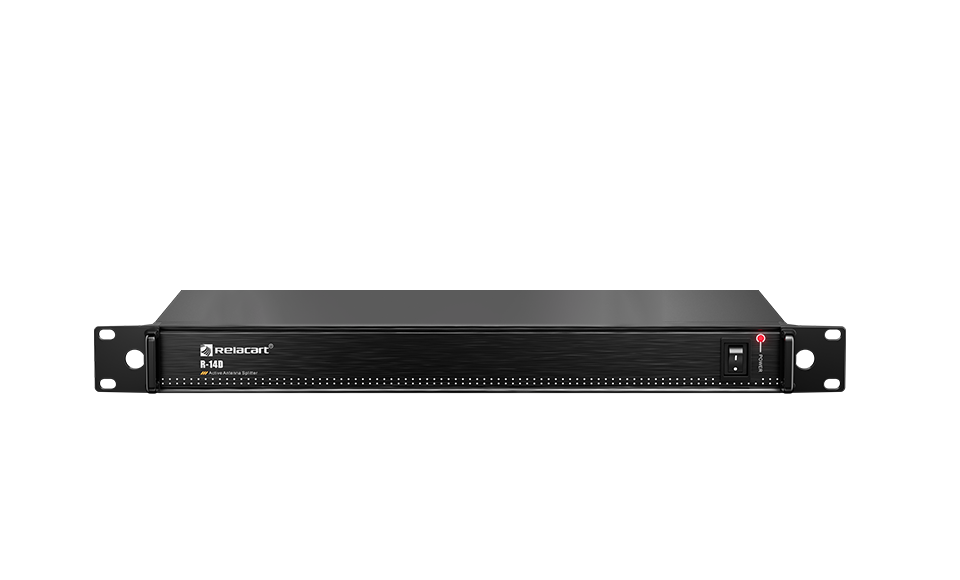
A room with good antennas often serves several receivers at once. Run each receiver back to the antenna tree instead of adding antennas per receiver: one layer of the R-14D active distribution (500-950 MHz, 0 dB per-port gain) feeds four receivers without loss, and a passive R-12S handles light duty at 3.5 dB per split. The full arithmetic lives in our antenna distribution guide.
One disciplined antenna tree beats five improvised ones - which is exactly how racks drift into the 7 dB passive-cascade problem that produces through-wall dropouts in the first place.
When Should You Stop Fighting the Wall?
Sometimes the honest answer is architectural. Reinforced concrete shafts, lift cores and low-E glazed facades charge 15-30 dB and more - beyond what any antenna upgrade politely recovers. The professional options, in order of preference: put the receiver (or a remote antenna) in the same room as the performers; run cable where radio will not go; or treat the two spaces as separate RF zones, each with its own coordinated plan.
A note on expectations rather than gear: whatever the setup, confirm that the frequencies you plan to use are permitted in your country before installing across a campus or a multi-room venue - UHF allocations differ by market, and this article deliberately makes no claim about any country it has not verified.
A Field Routine That Catches Wall Problems Early
None of the fixes above require lab instruments - they require a twenty-minute survey with one transmitter and a notebook, done before the system is permanently installed.
The survey also produces the single most valuable artefact a venue can own: a one-page antenna map. When a new engineer inherits the room, the map answers in ten seconds what usually takes an hour of "where does this cable go" archaeology - and it makes every future expansion a drawing exercise instead of a discovery process.
- Walk the venue once with a transmitter and count walls, marking every concrete or coated-glass surface on the plan
- Place remote antennas in the performance room wherever the wall budget already exceeds 10-12 dB
- Space the two receiver antennas several metres apart to break up multipath cancellation points
- Test at show conditions - full audience, all wireless gear on - not in an empty room
- Log the two or three weakest stage positions; if they repeat show after show, it is multipath, not interference
Frequently Asked Questions
Does a higher-gain antenna "boost" the signal through a wall?
It points more of the signal where you aim it - 7 dBi on the R-20U means most of the energy goes into an 80-degree cone instead of everywhere. That recovers link budget, but a 25 dB reinforced-concrete wall will still beat any antenna. Aim around the wall, not through it, when possible.
Why does my dropout spot stay exactly the same every performance?
Multipath cancellation points are fixed by the room geometry, not the performer. True diversity reception with well-spaced antennas removes most of them, which is why it is standard on professional receivers.
Is it better to put the receiver on stage instead?
Putting the receiver in the performance room is often the right call, but stage-floor receivers pick up every lighting rig dimmer and video wall in the building. A remote antenna feeding a rack-mounted receiver in a quiet control room is usually the cleaner architecture.