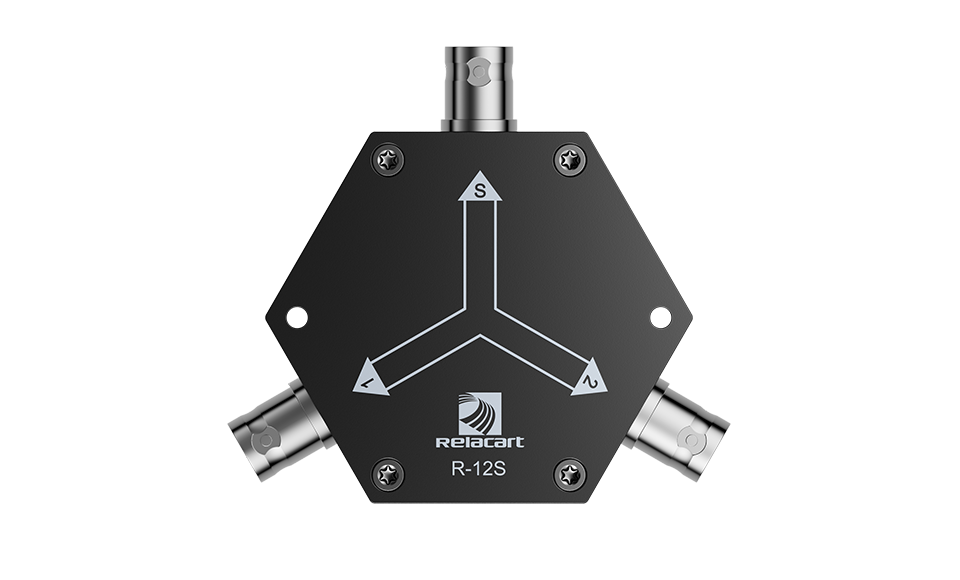
The R-12S antenna divider: at 8 channels, how you share one antenna pair matters as much as how many receivers you own
Channel count is the first spec buyers compare, and the last one they fully understand. The honest answer to "4 or 8?" is that moving from 4 to 8 channels changes the engineering around the receivers - antennas, frequency planning, rack and power - far more than it changes the receivers themselves.
This guide compares the two sizes with concrete deployment numbers: what a 1U chassis really holds, how much tuning range an 8-channel plan needs, and where antenna distribution becomes the real bottleneck. Every figure quoted here comes straight from the product specification pages on this site, from the UR-2Q quad-channel system to the R-series antenna hardware.
If you are still deciding between single, dual and four-channel units, start with Single vs Dual vs Four-Channel Wireless Microphone Systems - this article deliberately does not repeat that comparison. Here we look at what happens past four.
What a Channel Actually Costs You
Each wireless channel is four things, not one: a transmitter, a receiver slice, a legal frequency slot, and an antenna path. The first two scale linearly - buy twice the gear, get twice the channels. The last two do not.
Interference planning is the part that sneaks up on you. Any two transmitters can mix and produce intermodulation products that land on a third channel. With 4 active channels there are 6 possible transmitter pairs to worry about; with 8 channels there are 28. The problem does not double - it compounds. This is why an 8-channel show needs a frequency plan written down before the first microphone is switched on, while a 4-channel meeting can often be set by ear in ten minutes.
There is a third cost that rarely appears on a quotation: coordination time. A 4-channel room can be re-tuned by one person between sessions. An 8-channel event needs someone who owns the plan - who scanned the venue, who knows which slot belongs to which transmitter, and who says no when a visiting engineer asks to borrow "that free-looking frequency". Budgeting an hour of planning for every additional four channels is a realistic starting rule.
When Are 4 Channels Still the Right Answer?
If your busiest moment uses four or fewer microphones at once - a panel discussion, a worship service with pulpit and choir leads, a corporate meeting with two handhelds and two bodypacks - a quad receiver is the efficient answer, because one chassis carries all four channels.
The UR-2Q packs four true-diversity channels into a single EIA 1U frame (480 x 350 x 43 mm) with a 130 MHz tuning band across 521.25-936.85 MHz. One power feed (AC 100-240 V), one antenna pair on dual BNC connectors with +12 V/150 mA bias, one Dante port for the audio network.
- One chassis, four channels — a full quad system in 1U, with 96 kHz / 24-bit audio and S/N above 105 dB
- 130 MHz tuning band — 521.25-936.85 MHz hardware range, which matters the moment your channel plan grows
- One antenna pair — dual BNC antenna inputs with +12 V/150 mA output for remote powered antennas
- Dante on board — mixed and per-channel balanced outputs plus an Ethernet port for Dante networks
For a fixed-install meeting room or a house of worship running four voices at once, that single 1U box - plus one good antenna pair - is a complete system. There is no distribution hardware to buy and no frequency plan to maintain, because the receiver coordinates its four channels internally.
What Changes When You Go to 8 Channels?
Three things change at once, and buyers usually only plan for the first.
First, spectrum. Eight channels need eight frequency slots spaced far enough apart that their intermodulation products miss every other slot. Common planning practice for analog FM systems with roughly 45 kHz deviation keeps several hundred kilohertz between adjacent slots, which means 8 channels want several MHz of clean spectrum, not one. Second, antennas. Eight receivers each pulling from the same stage means eight antenna inputs, which is where distribution hardware enters the picture (next section). Third, documentation. At 8 channels the plan lives on paper or in software - re-tuning by ear after a cable swap is how same-spot dropouts are born.
Rack Space: The Math Nobody Does Until Move-In Day
Two UR-2Q units give you 8 channels in 2U. The alternative - four dual-channel units such as the HR-32D or UR-280 - costs 4U for the same 8 channels, plus twice the power feeds, twice the audio looms and twice the antenna runs.
Depth is the spec that gets forgotten. The UR-2Q measures 480 mm front-to-back; the HR-32D and UR-280 are 410 mm. A shallow 450 mm rack that accepts dual-channel receivers happily will not close its rear door around a quad chassis plus a right-angle BNC. Measure the rack, not the brochure.
Why Does Tuning Range Matter More at 8 Channels?
A dual-channel UR-280 works within a 64 MHz bandwidth (depending on the region). The UR-2Q and the HR-32D carry a 130 MHz bandwidth in the same 521.25-936.85 MHz hardware range (again region-dependent). The wider the tuning window, the more room a frequency coordinator has to dodge a local interferer without re-purchasing transmitters.
At 4 channels, 64 MHz is usually comfortable. At 8 channels and beyond, the extra headroom stops being a luxury: local broadcasts, camera links and visiting productions all compete for the same slices, and regional rules about which UHF slices are legal differ from country to country. A wideband receiver lets one fleet serve several plans; it does not make any specific frequency legal - that is always your national regulator's call.
What Does This Mean for Rental Fleets?
Rental houses feel the 4-vs-8 decision twice: once in the warehouse, once on site. In the warehouse, a fleet of quad receivers means every case is a self-contained 4-channel block - one chassis, one power supply, one antenna pair - that can be counted out to a job in minutes. A fleet of singles means every job is an eight-way jigsaw of bodies, power bricks and antennas.
On site, the quad pattern halves the set-up and strike time, because half the devices to place, cable and test are racks. And when a job grows from 4 to 8 channels, adding a second UR-2Q duplicates an existing block rather than starting a new architecture: same bandwidth behaviour, same Dante port pattern, same rack depth.
The counter-case is the fixed install with permanently two live microphones - a council chamber, a small chapel. There, a dual-channel chassis such as the HR-32D or UR-280 spends less, runs from the same AC 100-240 V supply, and leaves rack space free for the things that room actually needs.
Antennas and Distribution: The Part That Actually Fails
Every receiver wants its own antenna pair, but a stage does not need eight antennas bolted to it. The correct pattern at 8 channels is one or two good antennas feeding all receivers through distribution.
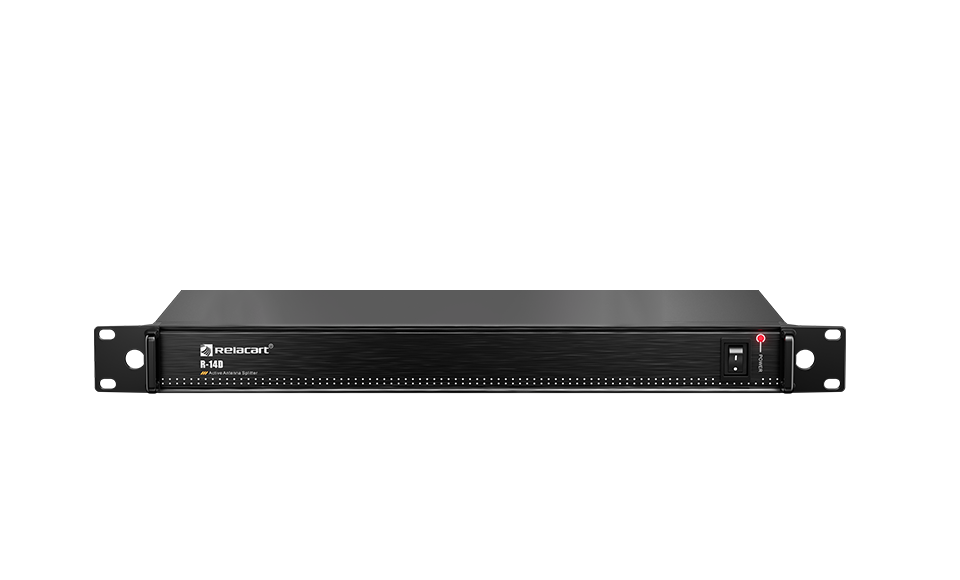
The passive route is the R-12S antenna divider: 400-1000 MHz, 50 ohm, with 3.5 dB (plus or minus 1 dB) insertion loss per split. Cheap and bulletproof, but every split costs you signal, and cascading dividers compounds the loss. The active route is the R-14D four-channel distribution system: 500-950 MHz with 0 dB (plus or minus 1 dB) output gain per port - it feeds four receivers from one antenna pair without charging them any loss, and biases each receiver port at +12 V DC / 150 mA.
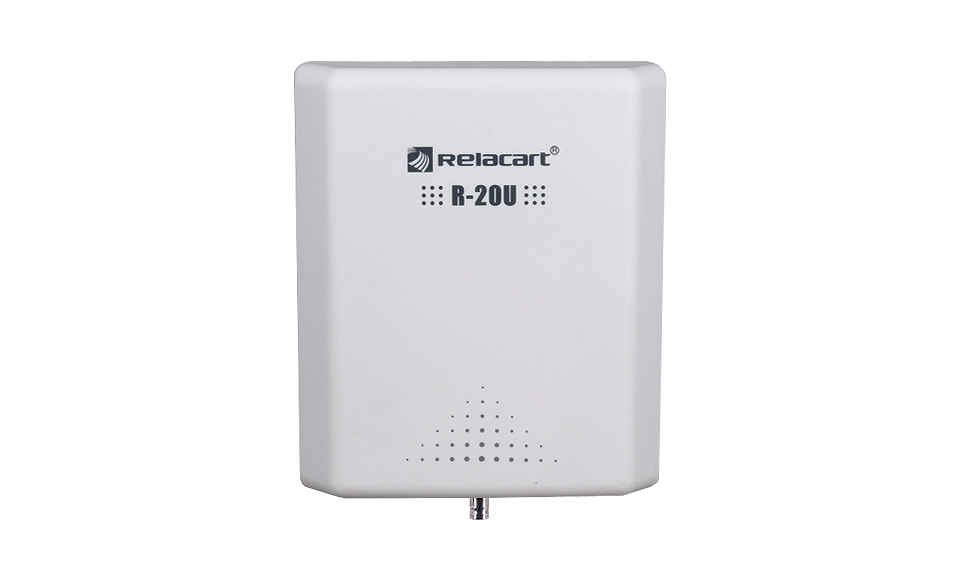
A concrete 8-channel layout: two UR-2Q receivers fed by one R-14D, which in turn is fed by a pair of R-32AU active directional antennas (470-950 MHz, at least 6.5 dB antenna gain, 0-15 dB adjustable amplifier). The R-14D even powers those antennas over their coax at 75 mA each - no mains outlet at the antenna position. Two antenna cables leave the stage area; eight receivers consume them.
Passive vs active antenna distribution for an 8-channel rack
| Attribute | R-12S passive divider | R-14D active distribution |
|---|
| Frequency range | 400-1000 MHz | 500-950 MHz |
| Per-port gain | -3.5 dB +/- 1 dB (loss) | 0 dB +/- 1 dB (no net loss) |
| Isolation | better than -20 dB | active buffering per port |
| Power | none (up to +50 V DC / 1.5 A pass-through) | AC 100-240 V, 800 mA drain |
| Choose when | 2-4 receivers, short cable runs, strong signal | 4+ receivers, long runs, or amplifier antennas on stage |
The failure mode to design against is the improvised one: two passive dividers stacked because the rack outgrew its plan. Two split levels remove about 7 dB before a metre of coax is counted, and the symptom - dropouts at fixed stage positions - gets misread as interference. Our antenna distribution guide walks the full loss arithmetic.
How Do Real Deployments Split the Difference?
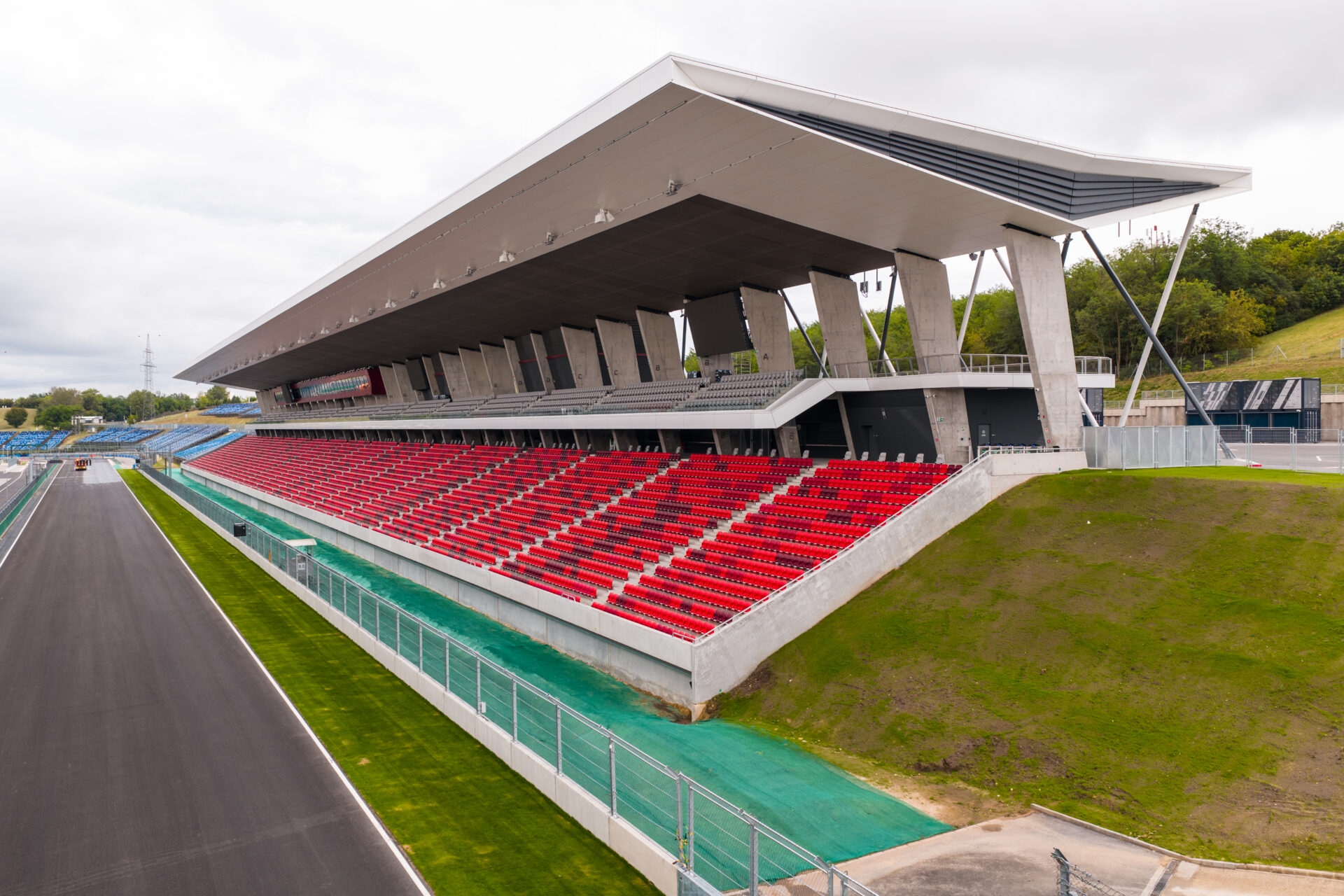
A useful reference point: the Hungaroring circuit redevelopment in Hungary deployed nine UR-2Q quad receivers across the paddock and grandstand areas - 36 channels of event commentary and coordination in one of the most RF-hostile environments in live sport, with broadcast cameras and comms sharing the air.
At the other end of the scale, a Papua New Guinea rugby field project delivered through a China Railway Construction contractor runs quad-channel UR-2Q systems for match-day presentation - a case where one 1U chassis per four voices keeps the equipment budget and the install simple.
The pattern in both cases: quad receivers chosen not as a compromise, but because grouping four channels per chassis halves the rack, halves the antenna runs and keeps every four-channel group self-contained.
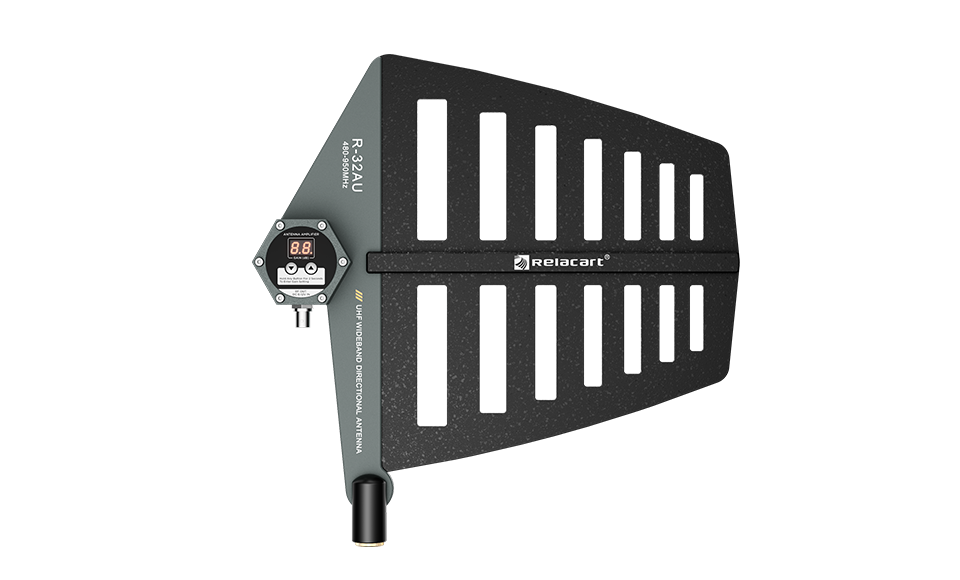
R-32AU active directional antennas overlooking the Hungaroring grandstand - one antenna pair serving a nine-receiver event
A Decision Table You Can Use in the Showroom
None of these rows require equipment you cannot see on this site. What they require is deciding before purchase, because the cheapest 8-channel system is the one planned as an 8-channel system - not four separate purchases later glued together.
Sizing wireless systems by simultaneous microphone count
| Simultaneous mics | Typical venue | Chassis pattern | Antenna plan | Watch out for |
|---|
| 1-4 | Meeting rooms, small worship, panels | One UR-2Q (1U) or two HR-32D (2U) | One antenna pair, direct or one R-12S split | Almost nothing - keep 400 kHz between slots |
| 5-8 | Club stages, mid-size events, council chambers | Two UR-2Q (2U) | One R-14D feeding both receivers, or two R-12S splits | Write the frequency plan down; mind rack depth (480 mm) |
| 9-16 | Festivals, arena corporate shows | Three to four UR-2Q (3-4U) | R-14D layer plus R-32AU active antennas | Intermod planning is now mandatory; scan the venue, not the datasheet |
Frequently Asked Questions
Can I just buy two quad receivers instead of planning antennas?
You can, and it will work on the bench. In a venue, eight antennas on a stage means eight chances for multipath and eight cable runs to trip over. One R-14D distribution layer plus two R-32AU antennas is both cheaper and quieter.
Does the 130 MHz bandwidth of the UR-2Q make any frequency legal?
No. The receiver can tune 521.25-936.85 MHz, but which slices you may transmit on depends entirely on your country. Check your national regulator before coordinating; regional availability is also why some spec sheets mark bandwidth "depending on the region".
Is 8 channels the practical maximum in one rack?
Not even close. Four UR-2Q units reach 16 channels in 4U with one distribution layer - the constraint is spectrum and antenna planning, not rack space. See the next article in this series for a full 16-channel rack worked out in numbers.