Frequency selection starts with a measurement, not a guess
Our earlier guide, how to connect a UHF wireless microphone system, covers the wiring. This companion covers the other half of a working system: choosing the frequencies the wiring will carry. The order matters - frequencies first, cables second - because a perfectly connected system on an occupied frequency still fails.
The workflow below takes one person about thirty minutes in a mid-size venue, uses only hardware documented on this site, and cites only regulatory ranges verified from CEPT and FCC primary sources.
Which Frequencies Are Legal Where You Operate?
Selection starts with the law, because the quietest frequency in the building may still be somebody else's assignment. Verified reference points: in the CEPT region, professional wireless microphones share 470-694 MHz as the core PMSE band, and 863-865 MHz is licence-exempt at typically 10 mW e.r.p. In the United States, FCC Section 15.236 permits unlicensed operation at 50 mW EIRP in 470-608 MHz and 20 mW EIRP in the 614-616 MHz and 657-663 MHz gaps, with licensed Part 74 operation available to professional users.
Outside those two reference regions, do not assume: national administrations allocate differently, and several markets have re-farmed slices of UHF in the last decade. One check with the national regulator - before writing any plan - prevents the most expensive mistake in this entire workflow.
How Do You Find the Quiet Slots?
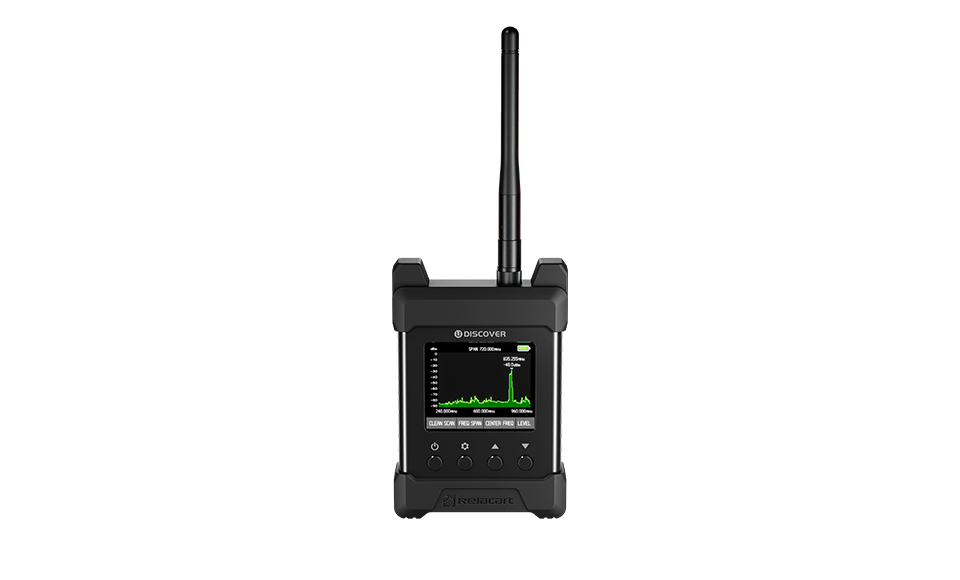
Scan the venue, not the datasheet. A receiver scan only shows what your own hardware can hear; a dedicated analyzer shows every occupant of the band. The U.Discover detects 240-960 MHz in 1 MHz steps with a 90 dB dynamic range and an amplitude floor of -110 dBm, in a 150-gram package that charges over USB Type-C - the kind of tool that lives in the kit bag rather than the warehouse.
Walk three positions: the stage, the control position, and the point of the venue furthest from both. Note every occupied slice, then shortlist the windows that are quiet at all three positions. Those windows - not the quietest single reading - are your candidates, because the audience will fill the room between the stage and the lobby.
What Spacing Keeps Your Own Channels Apart?
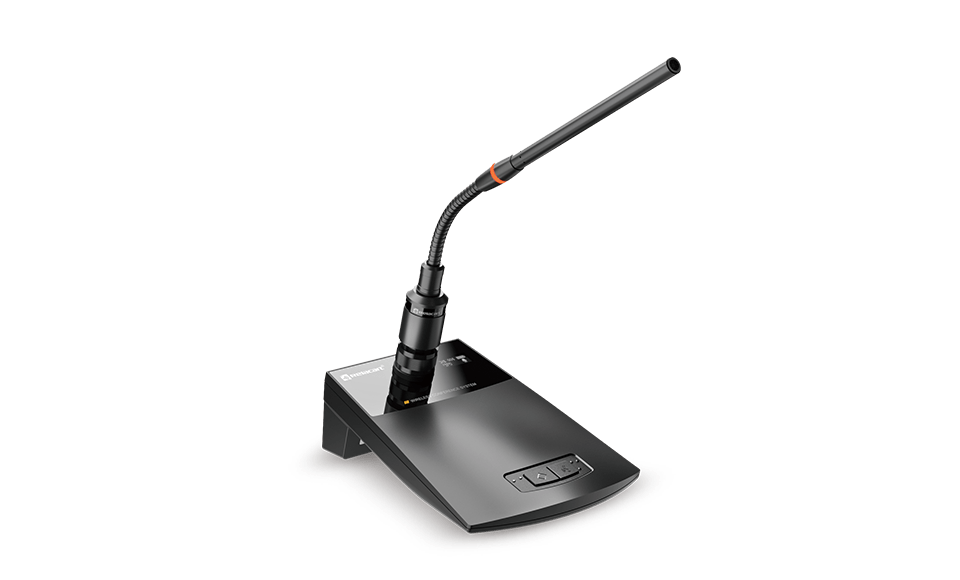
Your own transmitters are the interferers you control. Three deviation figures from this site's product pages set the scale: handhelds and conference units such as the UH-222 and WDC-903 units work at plus or minus 45 kHz maximum deviation, while the PM-320 stereo link runs plus or minus 48 to 50 kHz. FM channels with those deviations need several hundred kilohertz of carrier separation as the common planning baseline.
Spacing alone is not enough once channels multiply: every pair of carriers generates third-order products (2f1 - f2 and 2f2 - f1) that can land back inside your own window. From eight channels up, place carriers so every product lands in a guard window - the full arithmetic and the pair-count table are in the intermodulation planning guide. Below eight channels, uneven carrier spacing (never an even ladder) plus the spacing baseline is usually sufficient.
The 863-865 MHz licence-exempt window deserves a special caution: at 2 MHz wide and shared with consumer devices, it serves one or two channels well and more poorly - it is a backup window, not a plan.
Where Does Tuning-Range Headroom Pay Off?
Tuning range is the difference between re-tuning and re-buying when the spectrum shifts - a broadcaster changes its assignment, a neighbouring venue powers up a new fleet, the regulator re-farms a slice. The hardware ranges on this site (all region-dependent, as the product pages state) illustrate the ladder:
The UR-2Q and HR-32D carry 130 MHz tuning bands across 521.25-936.85 MHz; the UR-280 carries 64 MHz; the WDC-903's wireless units carry 134 MHz; the PM-320 monitor link carries 32 MHz inside 470-936 MHz. Wider is not automatically better - it is proportional to how often your plans must dodge, and how many channels each dodge must move.
The band-versus-band question (UHF versus the licence-exempt 2.4 GHz band) is a separate decision with its own trade-offs, compared in UHF vs 2.4 GHz for live sound.
Deployment type to band strategy
| Deployment | Channels | Band strategy |
|---|
| Meeting room / chapel | 1-4 | One narrow window; licence-exempt options viable |
| Multi-function hall | 4-8 | One wide UHF window, spacing-checked, one backup slot |
| Theatre / mid festival | 8-12 | Wide UHF band, intermod-computed set, on-site scan verify |
| Festival / stadium | 12+ | Wideband fleet, reserved backup slots, coordinator owns the plan |
What Goes in the Written Plan?
- The regulatory check: which window is legal in this country, with the source noted
- The venue scan: date, positions walked, occupied slices marked
- The carrier list with spacing and product check, plus one or two reserved backup slots
- The assignment: which receiver and transmitter holds which slot
- The re-tune rule: who may move a channel mid-show, and to which alternatives
What Comes After Selection?
Two habits keep a good plan good. Re-scan before every event in a new venue or a new season - spectrum does not respect last month's plan. And when interference appears despite the plan, work the fault tree in the RF interference guide rather than re-tuning at random; the symptom-to-action map there saves the random walk.