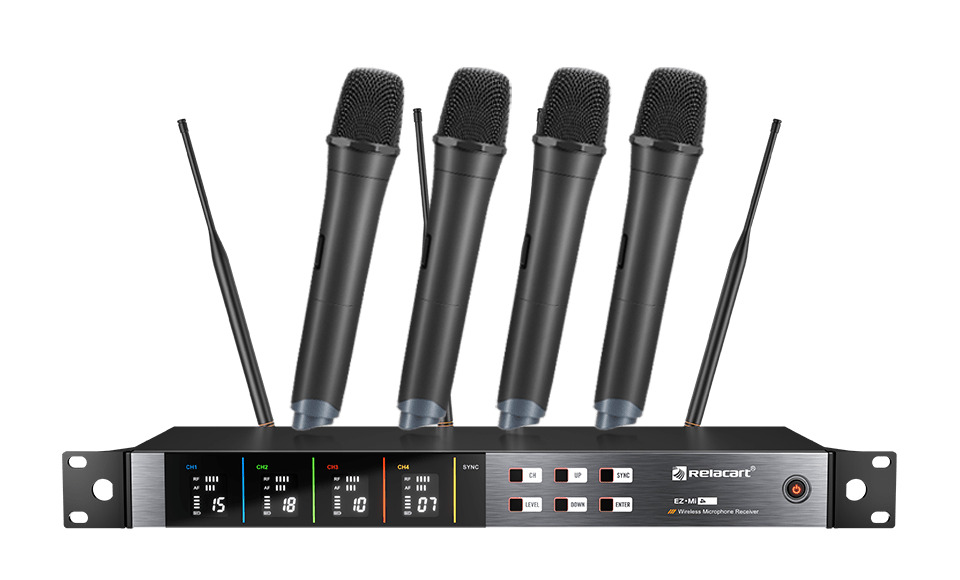
Relacart EZ-MI-4: four channels of true-diversity reception in a single 1U chassis
Channel count is the most misunderstood number on a wireless microphone datasheet. It is not a measure of audio quality — it states how many simultaneous microphones one receiver can carry, and therefore how much rack space, cabling and frequency coordination a room needs.
This guide compares single, dual and four-channel systems using Relacart’s EZ.Mi range as the worked example, because EZ.Mi1, EZ.Mi2 and EZ.Mi4 share one platform: the same 521.25–936.85 MHz carrier range, the same 48 kHz DSP companding and the same true-diversity reception.
What a Channel Actually Is
One channel equals one transmitter plus one set of receiver circuitry dedicated to it. A single-channel receiver such as the EZ.Mi1 carries one microphone; the dual-channel EZ.Mi2 carries two; the EZ.Mi4 carries four. All three use true-diversity, superheterodyne reception and share the same audio specification: 92 dB dynamic range, 105 dB signal-to-noise ratio (A-weighted) and no more than 0.8% total harmonic distortion at 1 kHz.
Because the platform is shared, changing channel count changes the packaging, not the audio. The EZ.Mi1 fits a half-1U metal chassis; the EZ.Mi2 and EZ.Mi4 occupy a full 1U.
Side-by-Side Comparison
Table 1 — EZ.Mi series channel counts compared
| Factor | EZ.Mi1 (single) | EZ.Mi2 (dual) | EZ.Mi4 (four) |
|---|
| Microphones carried | 1 | 2 | 4 |
| Chassis | Half 1U, metal | 1U, metal | 1U, metal |
| Receivers needed for four microphones | 4 | 2 | 1 |
| Carrier range | 521.25–936.85 MHz | 521.25–936.85 MHz | 521.25–936.85 MHz |
| Audio path | 48 kHz DSP companding, true diversity | 48 kHz DSP companding, true diversity | 48 kHz DSP companding, true diversity |
| Typical application | One lectern, one presenter | Two presenters, or handheld plus bodypack | Panel of four, small stage |
When One Channel Is Enough
A single-channel system is the right answer when one person speaks at a time and the receiver lives next to the mixer: a lectern in a meeting room, a presenter in a classroom, a single vocal in a small venue.
The EZ.Mi1 keeps that case as compact as it can be — a half-1U metal chassis, dozens of selectable frequencies and infrared synchronisation between transmitter and receiver.
When Two Channels Pay for Themselves
Two channels fit the pattern of a paired conversation: an interviewer and an interviewee, a moderator working alongside a presenter, or a handheld and a bodypack used by the same person at different moments.
One dual-channel receiver replaces two single-channel units. That halves the rack units, the power adapters, the audio cables and the antenna count — and because the EZ.Mi2 shares the EZ.Mi platform, no audio setting has to change.
When Four Channels Make Sense
Four channels cover a panel discussion, a small stage, or a room where two handhelds and two bodypacks run at the same time. The EZ.Mi4 does it in a single 1U chassis with the same audio specification as its single-channel sibling.
Above four channels the arithmetic changes: the constraint stops being rack space and becomes frequency coordination. That is where a wideband multi-channel platform such as the UR-2Q — four channels of true diversity in a 130 MHz switching bandwidth, with AFS automatic frequency search and Dante output — becomes the more appropriate tool.
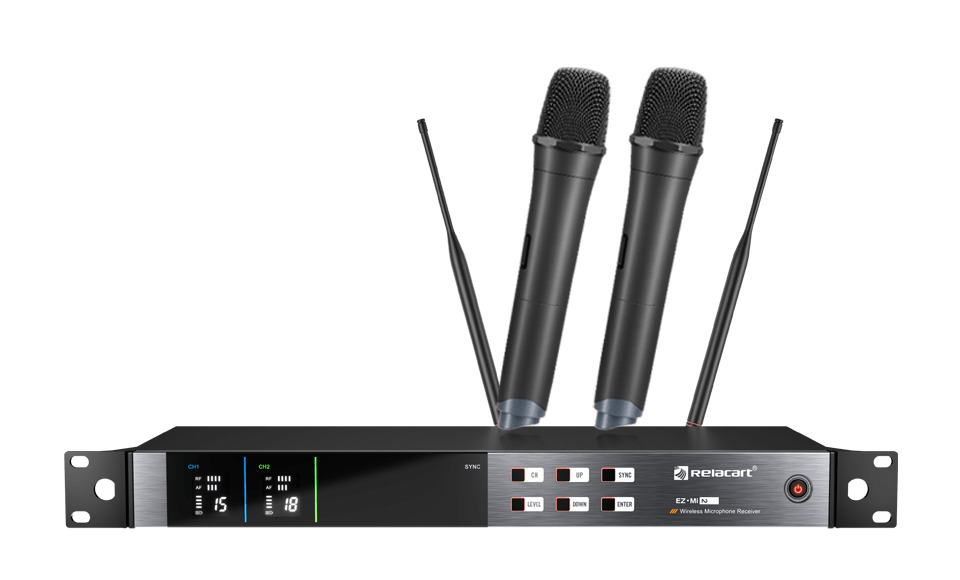
Relacart EZ-MI-2 dual-channel system with two handheld transmitters
Frequency Planning: The Constraint Nobody Prices In
Every channel needs a clean frequency slot, and slots are not free — they must be spaced to avoid intermodulation. A four-channel receiver does not remove that requirement; it centralises it.
The platform decides how much room you have. Relacart’s UR-D2 digital system, for example, fits 20 simultaneously operating transmitters into an 8 MHz window and more than 60 compatible channels into a single operating band, which is what makes high channel counts practical in congested RF environments.
A practical rule: buy the channel count you will run simultaneously, plus one spare slot for a guest microphone. Buying more receiver channels than you can coordinate gains nothing.
Scaling Without Changing Platform
Because EZ.Mi1, EZ.Mi2 and EZ.Mi4 share one carrier range and one audio path, a room can start with a single channel and add channels later without replacing transmitters or re-training operators. The infrared sync procedure and the frequency plan carry over.
The same logic applies across platforms: a UR-D1 single channel and a UR-D2 dual channel share the 64 MHz system bandwidth, so a deployment can grow from one to two channels inside the same frequency plan.
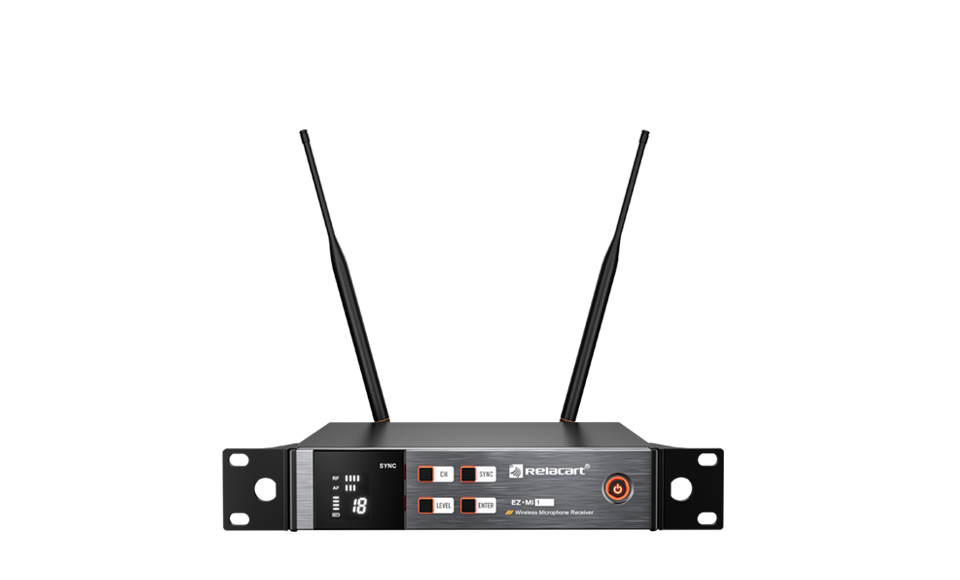
Relacart EZ-MI series true-diversity receiver
Frequently Asked Questions
Does a dual-channel receiver sound better than two single-channel receivers?
No. On a shared platform such as EZ.Mi the audio path is identical — 48 kHz DSP companding, 92 dB dynamic range, 105 dB signal-to-noise ratio. The difference is packaging and cabling.
Can I add a second channel to a single-channel system later?
Yes — either by adding another receiver, or by moving to a dual- or four-channel receiver on the same platform. The EZ.Mi series shares one carrier range across all three channel counts.
What limits how many wireless microphones can run at once?
Available spectrum and intermodulation, not the receiver’s channel count. Relacart’s UR-D2 fits 20 transmitters into an 8 MHz window; planning still has to keep those 20 on mutually compatible frequencies.
Is a four-channel receiver harder to set up?
It needs four coordinated frequency slots instead of one, but setup is centralised in one chassis, and the EZ.Mi4 uses the same infrared synchronisation as the rest of the range.
How does the EZ.Mi4 differ from the UR-2Q four-channel system?
The UR-2Q adds a 130 MHz switching bandwidth, AFS automatic frequency search, Dante network audio output and nine Magic EQ voicings, placing it at a higher level of the range.