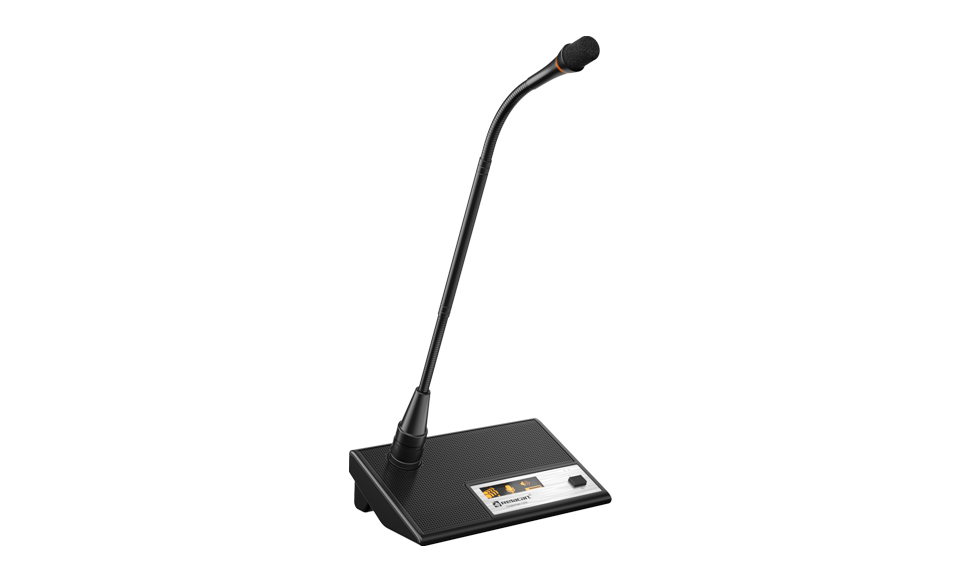
The BG-24 receiver platform - a 2.4 GHz digital design whose performance profile follows directly from its GFSK modulation choice.
Ask two engineers what makes one digital wireless microphone system better than another and you will rarely hear about the microphone. You will hear about the modulation - the scheme that decides how many bits ride each radio symbol, how the transmitter amplifier behaves, how much spectrum a channel eats, and how fast audio arrives at the output.
The industry has converged on three mainstream schemes: QPSK, its differential refinement π/4-DQPSK, and GFSK. None is universally "best"; each trades spectral efficiency against hardware cost and deployment flexibility in a different direction. This article explains how each scheme works, what it costs, and which applications each one genuinely fits - the same logic our own product families follow, from the UR-D flagship series (QPSK) through the EZD.Mi series (π/4-DQPSK) to the BG-24 series (GFSK).
Modulation in One Paragraph, Then the Consequences
Digital modulation encodes binary data onto a radio carrier by manipulating its phase, frequency or both. Two properties dominate the engineering consequences. The first is spectral efficiency: how many data bits each symbol carries and therefore how much information fits in each hertz of spectrum. The second is the envelope: whether the transmitted signal's amplitude stays constant or varies. A constant envelope lets the power amplifier run in an efficient non-linear mode; a non-constant envelope demands a linear amplifier, which costs more and consumes more power.
Everything else a buyer cares about - channel density, latency, interference tolerance, even battery life - cascades from those two properties. Which is why the modulation decision is made first, and the product positioning follows.
QPSK: Maximum Information per Hertz
QPSK (Quadrature Phase Shift Keying) controls the carrier's phase across four states - 0°, 90°, 180° and 270° - so each symbol carries two bits and spectral efficiency reaches 2 bits/s/Hz. That efficiency is why QPSK anchors professional digital wireless, broadcast transmission and satellite communication: in a crowded UHF band, carrying more audio data per hertz directly translates into more simultaneous channels on the same spectrum.
The scheme's strengths suit demanding live work. QPSK resists multipath fading and complex RF interference well, supports high-bit-rate audio - our UR-D flagship series delivers 24-bit/48 kHz with under 3 ms of latency - and remains stable when advanced encryption is layered on top of the link. Combined with true diversity reception, it holds transmission quality over longer distances and through obstructions better than narrower designs.
The cost is hardware. QPSK is a non-constant-envelope scheme, so the RF power amplifier must be linear, which demands more advanced RF design and manufacturing precision. That is the price of top-tier spectral performance, and it is why QPSK designs position at the professional end of the market: large-scale live performance, 4K broadcast production and high-security conferences where confidential audio transmission matters.
π/4-DQPSK: The Balanced Middle Path
π/4-DQPSK is an optimised refinement of QPSK built on differential encoding. Its clever part is the phase trajectory: transitions between adjacent symbols are limited to ±90° and ±135°, which completely avoids the 180° phase reversal a conventional QPSK symbol can produce. Removing those abrupt jumps smooths the transmitted spectrum, lowering adjacent-channel radiation and easing the filtering burden around each channel.
The practical benefits stack up in deployment. Spectral efficiency stays at the full 2 bits/s/Hz of QPSK, so multi-channel density is preserved. Phase transitions are gentler, which improves resistance to Doppler shift - a real advantage when a presenter walks a stage wearing a bodypack. The power amplifier no longer needs the same linearity as pure QPSK, which simplifies hardware, trims cost and lands the scheme at an excellent performance-to-price point. Demodulation also synchronises faster, since the differential design does not require full carrier recovery, which speeds up infrared frequency pairing and reduces connection drop risk.
The trade-off is ultimate interference resistance: π/4-DQPSK gives up a little headroom against severe RF environments compared with standard QPSK. That makes it the ideal engine for mid-range commercial work - medium-scale conferences, professional commercial stages, education and training institutions, and multi-purpose halls - which is exactly where our EZD.Mi series operates.
GFSK: Efficiency of Hardware, Economy of Spectrum Trade-offs
GFSK (Gaussian Frequency Shift Keying) takes the frequency-shift-keying family and passes the data through a Gaussian low-pass filter before modulation. The filter smooths the frequency transitions, concentrating the spectrum and cutting side lobes dramatically - adjacent-channel interference sits below -60 dB, which matters enormously in the crowded 2.4 GHz ISM band where the BG-24 series lives.
GFSK is a constant-envelope scheme carrying one bit per symbol - 1 bit/s/Hz, half the spectral efficiency of the PSK family. But that constant envelope is also its superpower: the power amplifier can run non-linear and highly efficient, so transmission consumes less power and hardware costs fall. Demodulation is architecturally simple and fast, delivering extremely low latency - under 2.9 ms when encryption is disabled - which keeps audio precisely synchronised with video for content creators.
The 2.4 GHz ISM band adds a commercial dimension no UHF scheme can match: it is license-free worldwide. No frequency application, no regional licensing - the system works out of the box in any market, which is why GFSK dominates portable wireless audio, live streaming, short-form video production, mobile office applications and global travel kits. Its limitation is symmetry: lower spectral efficiency makes it the wrong tool for hundred-channel deployments, and the band itself shares spectrum with Wi-Fi, Bluetooth and every other 2.4 GHz device in the building. For small-scale events and multi-scenario portable use, though, that trade favours GFSK decisively.

The BG-24H handheld transmitter: 2.4 GHz license-free operation built on constant-envelope GFSK modulation.
The Three Schemes Side by Side
Read the table by columns, not rows: each scheme is internally consistent. QPSK spends hardware cost to buy spectrum efficiency and interference headroom. π/4-DQPSK buys most of that efficiency back at a friendlier hardware price. GFSK spends spectral efficiency to buy constant-envelope efficiency, ultra-low latency and a license-free band that works identically in every country.
Comparison of the three mainstream digital wireless modulation schemes.
| Property | QPSK (UR-D series) | π/4-DQPSK (EZD.Mi series) | GFSK (BG-24 series) |
|---|
| Spectral efficiency | 2 bit/s/Hz | 2 bit/s/Hz | 1 bit/s/Hz |
| Signal envelope | Non-constant | Non-constant (softer transitions) | Constant |
| Anti-interference | ★★★★★ | ★★★★☆ | ★★★★ |
| Power amplifier requirement | High linearity | Medium linearity | Non-linear (efficient) |
| Latency | < 3 ms | < 4 ms | ≤ 2.9 ms (encryption off) |
| Band | UHF | UHF | 2.4 GHz license-free ISM |
| Best suited to | Large performances, broadcast, high-density conferences, confidential scenarios | Medium conferences, commercial performances, education, multi-function halls | Live streaming, small meetings, mobile recording, global license-free deployment |
Why Spectral Efficiency Decides How Many Mics You Can Run
The arithmetic that matters at a venue is channels per megahertz. A traditional analog FM wireless system needs roughly 200-250 kHz of spectrum per channel and demands highly continuous spectrum resources, so it cannot exploit the fragmented gaps left between television carriers and other services. Digital designs change that equation twice over: Relacart digital wireless systems occupy only 125-200 kHz per channel, and digital signals can identify and use fragmented spectrum that analog architecture wastes.
The consequence shows up in the product specifications. Within a single 8 MHz block, the UR-D series sustains 20 systems operating simultaneously, and across its full frequency range achieves more than 60 compatible channels. The EZD.Mi series applies a 64 MHz ultra-wideband design to support 20-plus simultaneous channels in mid-size rooms. Even the 2.4 GHz BG-24 series coordinates 10 simultaneous systems through narrowband transmission - remarkable in a band with no licensing and heavy Wi-Fi traffic.
Spectral efficiency also multiplies the value of wide tuning hardware. As we explained in how many channels one rack can really run and the intermodulation planning guide, the number of clean, mutually compatible frequencies a venue can support is the binding constraint on any multi-channel show - and modulation efficiency widens that constraint from the physics up.
Encryption Lives in the Modulation Stage
One more reason modulation choice shapes a product's market: digital encryption integrates at the encoding and modulation stage, before RF transmission. The audio data stream is transformed into an encrypted stream that only a paired receiver holding the correct key can reconstruct - something an analog link, which transmits the audio as a bare continuously-varying waveform, simply cannot do.
Our UR-D and BG-24 series carry the AES-256 international encryption standard: a 256-bit key length that makes brute-force decryption practically impossible. For government confidential meetings, judicial hearings, financial launches and board-level negotiations, that capability is not an accessory - it is the reason the system was chosen. Analog transmission offers no equivalent defence; any receiver tuned to the same frequency can intercept the content.
How to Choose: Match the Scheme to the Gig
The decision collapses to four questions. How many channels must run simultaneously, and how fragmented is the local spectrum? If the answer is "a lot, in a crowded UHF environment", QPSK's 2 bits/s/Hz earns its hardware cost. Is the deployment mid-size and price-sensitive? π/4-DQPSK delivers the same spectral efficiency with softer hardware demands. Does the gear travel internationally and need to work without frequency licensing? GFSK on 2.4 GHz removes the regulatory question entirely. And is the content confidential? Then AES-256-capable digital platforms - UR-D or BG-24 - are the only family members that answer.
Band choice interacts with the modulation decision, and our UHF vs 2.4 GHz comparison covers that trade in depth. Antenna and diversity architecture then decide how the link survives the room - see true diversity versus antenna diversity for that layer. Modulation is the foundation of the stack, but it only pays off when the layers above it are chosen just as deliberately.
Which modulation gives the most simultaneous channels?
QPSK and π/4-DQPSK both deliver 2 bits/s/Hz, twice the spectral efficiency of GFSK. Combined with narrowband digital channel widths of 125-200 kHz, QPSK-based designs such as the UR-D series sustain 20 simultaneous systems within an 8 MHz block and more than 60 compatible channels across the band.
Is GFSK worse because it carries only 1 bit per symbol?
Not inherently. GFSK trades spectral efficiency for a constant signal envelope, which allows efficient non-linear power amplifiers, simpler demodulation, latency of 2.9 ms or less, and very clean adjacent-channel behaviour below -60 dB. In license-free 2.4 GHz applications those advantages usually matter more than raw bits per hertz.
Does modulation affect audio encryption?
Yes. Encryption is applied to the digital data stream before RF modulation, so only digital modulation platforms can integrate it. AES-256 encryption is available on the UR-D and BG-24 series; analog FM transmission has no built-in encryption mechanism at all.