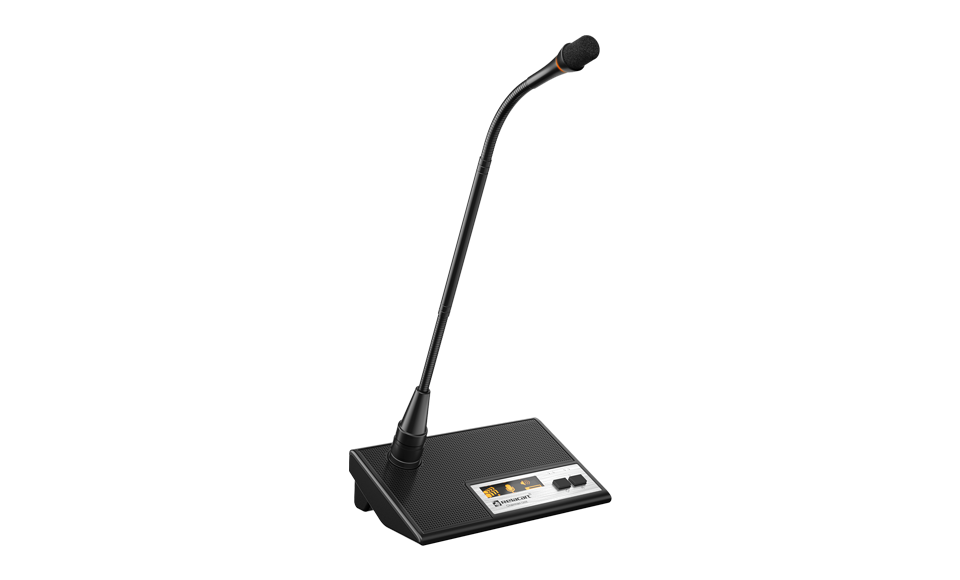
Certification marks are printed on the product for a reason: they tie the hardware in front of you to a documented test
Certification marks are the most quoted and least understood line in pro audio quotations. Buyers see "CE" and "FCC" and assume a product is legal everywhere; the truth is narrower and more useful. This guide explains what each mark on a wireless microphone or conference system actually certifies, which regulatory ranges apply in the major markets, and - most practically - how to verify a supplier's certificate before your shipment leaves the factory.
Regulatory figures quoted here come from primary sources (CEPT recommendations and the US Code of Federal Regulations); everything beyond those verified ranges is stated as "check your national regulator", because a certification guide that invents country rules would be worse than none.
Why Do Wireless Products Carry Certification Marks?
A radio product can interfere with two things: other radio services, and the mains or the person holding it. Certifications therefore cluster into radio and EMC testing (does it transmit where it claims, within power limits, without spurious emissions), safety testing (electrical safety), and environmental compliance (restricted substances).
The RF side is what makes wireless microphones special: the same physical product may be legal in one country and illegal in the next, purely because of where its tuning band sits relative to that country's allocations. That is why serious manufacturers ship the same hardware with different tuning-band configurations by region - and why the honest datasheet says "depending on the region" instead of quoting one global number.
What Does CE Marking Cover in Europe?
CE marking on a radio product declares conformity with the applicable EU directives - for a wireless microphone that means the radio equipment framework, tested against harmonised standards. For professional wireless microphones the relevant harmonised standard family is ETSI EN 300 422, which governs programme making and special events (PMSE) audio links in the 25 MHz to 3 GHz range.
The frequency side is defined nationally but coordinated regionally: in the CEPT region, ERC Recommendation 70-03 (Annex 10) designates 470-694 MHz as the core shared PMSE band, and 863-865 MHz as licence-exempt at typically 10 mW e.r.p. A CE-marked wireless microphone is not automatically legal on any frequency - the operator still tunes within what the national administration allows.
What Do FCC Rules Cover in the United States?
In the United States, unlicensed wireless microphone operation is defined in 47 CFR Part 15, Subpart D (Section 15.236): operation at up to 50 mW EIRP within 470-608 MHz, and up to 20 mW EIRP within the 614-616 MHz and 657-663 MHz gaps. Professional users can additionally be licensed under Part 74, which brings coordination and priority protections.
Two boundaries matter to buyers. Frequencies reassigned to other services (portions of the 600 MHz band) are off limits for wireless microphones. And "FCC certified" does not mean "any frequency legal" - the certification covers the equipment; the licence or licence-exempt status covers the operation. Both must check out.
The certification map for a wireless microphone purchase
| Mark / scheme | Region | What it proves | How to verify |
|---|
| CE + ETSI EN 300 422 | EU/CEPT | Radio and EMC conformity, PMSE testing | EU declaration of conformity + notified body number, model match |
| FCC (15.236 / Part 74) | United States | Equipment authorised for listed bands and powers | FCC ID searchable in the FCC database, model match |
| RoHS | EU and widely adopted | Restricted substances below limits | Declaration + test report from a recognised lab |
| CB Scheme (IECEE) | International | Safety tested to IEC standards, bankable across member countries | CB certificate + test report |
| CCC | China | National compulsory certification | CCC number on the CNCA database |
What About RoHS, CB and CCC?
RoHS restricts hazardous substances (lead, mercury, cadmium and others) in electronics; it is an EU requirement that most global buyers now copy into their own procurement standards, because one compliant bill of materials serves every market. The CB Scheme is the international shortcut for electrical safety: one IEC-based test report bankable across more than fifty member countries, which is why manufacturers serving multiple markets test once under CB rather than nationally everywhere.
CCC is China's compulsory certification for products sold in the domestic market. A factory serving China and export markets simultaneously typically holds CCC for domestic SKUs and CE/FCC/CB for export SKUs - asking which certificate covers which SKU is a legitimate and revealing audit question.
How Do You Verify a Supplier's Certificate in Minutes?
Three checks, all doable from a quotation document. First, the model name on the certificate must match the model on your purchase order exactly - family-level certificates ("UR series") do not prove unit-level conformity. Second, the certificate number should be checkable with the issuing body or database (FCC ID in the FCC database, CCC on the CNCA database, CB on the IECEE repository). Third, check the validity date and the reporting laboratory's name - a real certificate names a real lab.
A supplier who resists any of the three checks is telling you something. Everything a compliant manufacturer ships should trace to a document, which is the same principle our factory audit checklist applies to the whole relationship.
What Must the Buyer Still Do After the Sale?
Certifications clear the equipment; they do not tune it. The operator remains responsible for transmitting only on frequencies the national administration permits - the selection workflow (scan, verify, plan) is in our UHF frequency selection guide, and the band-versus-band trade-offs are compared in UHF vs 2.4 GHz.
Relacart products carry CE, FCC, CCC and RoHS certification, with CB scheme reports for safety, on the models designed for those markets - and each product page on this site publishes the operation manual and datasheet so the claims are auditable before the first enquiry.


