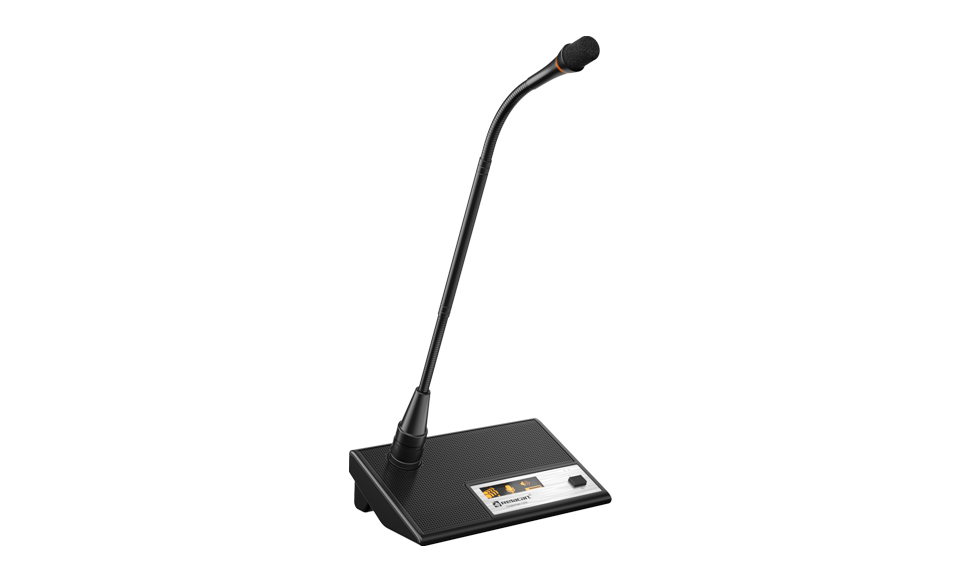
The RAM-124 digital matrix mixer: the level meters on its front panel are the everyday, audible face of bit depth - each division is a step the quantizer must resolve.
Almost every conference product datasheet carries three quiet numbers: a sampling rate, a bit depth and a channel count. They look like boilerplate, but they are the three decisions that shape how a digital audio system behaves - how much detail it keeps, how much noise it adds, and how far it scales. Buyers who can read these three numbers can spot overselling and under-speccing in seconds.
This guide walks through the arithmetic behind them, using the same figures our own platforms specify - the UR-2Q wireless receiver sampling at 96 kHz / 24-bit, the Dante networks our mixers join, and the conference systems that carry 40 to 110 seats on one bus. If you have read our guide to reading a wireless microphone datasheet, this is the layer underneath the noise figures: where those numbers come from in the first place.
From Sound Wave to Data: Three Steps Everyone Skips
Natural sound is a continuous acoustic wave. A microphone converts it into a continuously varying voltage - smooth and uninterrupted - and that analog signal is inherently fragile: it loses level over distance, absorbs interference from every cable it passes, and cannot travel on a network.
Digital audio converts that waveform into binary data in three steps. Sampling slices the wave into discrete points taken at a fixed rate. Quantization rounds each point's level to the nearest value on a fixed ladder of steps. Encoding writes the results as numbers a computer can store and move. Every digital audio device - microphone, wireless receiver, mixer, amplifier - relies on an ADC to get in and a DAC to get out, which is why these two converters sit at the heart of every product in this industry.
Each of the three steps has a quality dial. Sampling rate controls how often you look at the wave. Bit depth controls how finely you measure it. Channel count controls how many of these streams travel together. The rest of this article is about setting those dials sensibly.
Sample Rate: Why 48 kHz Became the Engineering Standard
Sample rate is measured in kilohertz, and the common tiers are familiar: 44.1 kHz (the CD standard), 48 kHz (the general standard for broadcasting and conferencing), and 96 or 192 kHz for professional recording and Hi-Fi capture. The rule behind them is simple - the higher the rate, the more waveform detail is captured and the cleaner the high frequencies - but the working rule of system engineering is more specific still.
Sound reinforcement, conferencing and Dante networked audio uniformly use 48 kHz. That is not conservatism; it is convergence. A conference chain involves a microphone, a wireless link, a mixer, a Dante network, a DSP and amplifiers, and every one of them must agree on one clock. Standardizing on 48 kHz means any compliant device can join the chain without resampling, and a gigabit network cable can carry hundreds of channels of 48 kHz / 24-bit audio without breaking a sweat - enough for the largest venues a conference system will ever serve.
So when does 96 kHz make sense? Where the capture link benefits from headroom - a wireless microphone digitizing at the capsule, for instance, can sample higher and process internally before anything reaches the network. Our UR-2Q quad-channel receiver is specified at 96 kHz / 24-bit audio sampling with S/N > 105 dB, and the UR-280 platform goes further to S/N > 110 dB with a 50 Hz - 18 kHz response within ±1 dB. The sampling happens inside the radio link; the network it feeds still runs at the room's common clock.
Bit Depth: The Arithmetic of Dynamic Range
Bit depth answers a different question: how finely is each sampled point measured? Sixteen bit is the CD standard; 24 bit is professional engineering mainstream; 32 bit appears in top-tier recording. The payoff is dynamic range, and the arithmetic is famously clean - each additional bit adds roughly 6 dB.
That gives 16-bit audio a dynamic range of about 96 dB, and 24-bit audio about 144 dB. For context, a well-built analog audio chain delivers roughly 60-70 dB of usable dynamic range before noise floors and headroom limits take over. This is the single most useful number pair in digital audio: it is why a 24-bit conference chain can carry both a whispered aside and a slammed door without clipping the one or burying the other in noise.
In a meeting room the practical effects are specific. Higher bit depth means quieter details survive - the speaker three metres from the table microphone does not fade into the noise floor - and loud moments do not clip. It also means gain staging becomes forgiving: the installer does not have to park every input at an exact level to keep the system clean, which is precisely the kind of margin a busy venue needs.

A digital mixer console such as the MiXX8.6 is where bit depth becomes audible: every fader position and meter segment is a level the quantizer had to resolve cleanly.
Channel Count and the Latency Budget
The third parameter is channel count. Mono - one channel - covers general paging and intercom. Stereo adds left and right for music and recording. Multi-channel systems of 4, 8, 16 or 32 channels serve theaters, cinemas and large-venue surround. Conference engineering lives across all three tiers: a discussion unit is mono, a room recording is stereo, and a campus-wide Dante deployment moves dozens of channels simultaneously.
One more number completes the set: latency, the time from transmission to reception. Stage and conference applications demand extremely low latency - under 10 ms is the working requirement - because audible delay between seeing a speaker and hearing them destroys the sense of a single conversation. Modern networked audio operates well inside that budget: Dante can achieve sub-millisecond latency at minimum, and precision clock synchronization keeps every device aligned to microsecond accuracy so multi-channel streams arrive together rather than stuttering apart.
A useful mental model ties all four numbers together: sample rate and bit depth set the quality of each channel, channel count sets the scale of the system, and the latency budget sets how tightly all of it can be synchronized. Change one and you reprice the others.
Why a Datasheet Can Say 96 kHz While the Network Runs 48
This is the question buyers ask most often, and it deserves a direct answer. A product spec such as 96 kHz / 24-bit describes the sampling and processing inside that device - for a wireless microphone system, the converter at the receiver output. A Dante network clock, by convention and by engineering practice, runs the room at 48 kHz. These are two different stages of the same chain, and both figures can be true at once.
The layers actually cooperate. The radio link digitizes at high resolution and delivers a clean, high-dynamic-range signal to the mixer or DSP; the network then carries that signal, at the room clock, to every destination - amplifier, recorder, overflow room, remote participant. Lossless transmission is preserved at both layers: uncompressed PCM inside the device, uncompressed transport across the network. Dante and AES67 are not file formats like WAV or MP3 - they are real-time transmission protocols for moving audio between devices, which is why nothing in the chain "compresses" your 24-bit signal into a smaller file.
The practical takeaway when comparing products: ask what the device does at its own conversion stage, and ask what clock the room runs at. A vendor who answers both precisely has a real system architecture; a vendor who quotes only one number is selling a spec, not a chain.
A Three-Question Checklist for the Next Datasheet
First: what does the device sample at - and does the figure describe its capture stage or just its marketing? Second: what bit depth, and does the rest of the chain preserve it - a 24-bit microphone feeding a 16-bit recording pipeline throws away the advantage it was bought for. Third: at what clock does the network run, and can every device in the room join it without resampling?
Where conference audio is concerned, the industry has effectively answered these for you: 48 kHz / 24-bit is the deployment standard, higher sampling lives inside the devices that benefit from it, and everything converges on one clock. Products like the UR-2Q wideband receiver and the DAM-series Dante digital mixers are designed around exactly that split - high-resolution capture on the edges, one coherent clock across the network.
The three quiet numbers stop being boilerplate the moment you can price them: what each setting buys, what it costs, and where in the chain it belongs.
Why does conference audio use 48 kHz instead of 96 kHz?
48 kHz is the converged standard for sound reinforcement, conferencing and Dante networked audio. Every device in the chain must share one clock, and standardizing at 48 kHz lets any compliant product join without resampling while a gigabit link carries hundreds of channels. Higher sampling is used where it helps - inside devices such as wireless receivers - before the signal reaches the room clock.
How much dynamic range does 24-bit audio actually add?
Each extra bit adds roughly 6 dB. 16-bit audio provides about 96 dB of dynamic range; 24-bit provides about 144 dB - far beyond the 60-70 dB usable range of a good analog chain. In practice, quiet speech stays above the noise floor and loud moments avoid clipping, with forgiving gain staging for the installer.
Is a 96 kHz spec on a wireless receiver wrong if Dante runs at 48 kHz?
No - the two figures describe different stages. 96 kHz / 24-bit describes the receiver's internal sampling and processing; 48 kHz is the network clock the room runs at. The receiver delivers a high-resolution signal to the network, which transports it losslessly at the room clock. Both numbers can be true simultaneously.