The discussion unit is the interface of a meeting: it must work every single time, which is why the chain behind it matters
Government and council chambers are the most conservative audio-buying environments in existence, and deliberately so. A meeting room that fails costs minutes; a legislative chamber that fails costs procedure. That is why the wired discussion system - the desk unit with the gooseneck and the request-to-speak button - has survived every wireless generation, and why the honest answer for many government rooms is still "wired first, wireless where cabling cannot reach".
This article gives the specification-level reasons, using the CS-302 chairman unit as the wired reference and the WDC-903 wireless system as the wireless counterpart, with numbers from their official pages throughout. The conceptual background is in what a conference discussion system is.
Why Do Government Rooms Still Choose Wired?
Determinism first: a wired chain has no spectrum to plan, no battery to charge, and no RF condition that changes when a broadcast transmitter powers up across town. The unit either works or it does not, and the failure mode is visible at the desk rather than intermittent.
Power discipline second: CS-302-series units draw their 24 V DC from the host system - there is no per-unit battery to cycle, store or replace, ever. For a room that meets weekly for twenty years, deleting the battery is deleting the largest recurring cost and the most common single point of failure (a flat cell on the day of the session).
Cost structure third: unit electronics are simple by design - one microphone capsule, a button set, an OLED, a loudspeaker - and the cabling is a one-time installation that the building amortises over decades.
What Should a Wired Unit Specification Actually Promise?
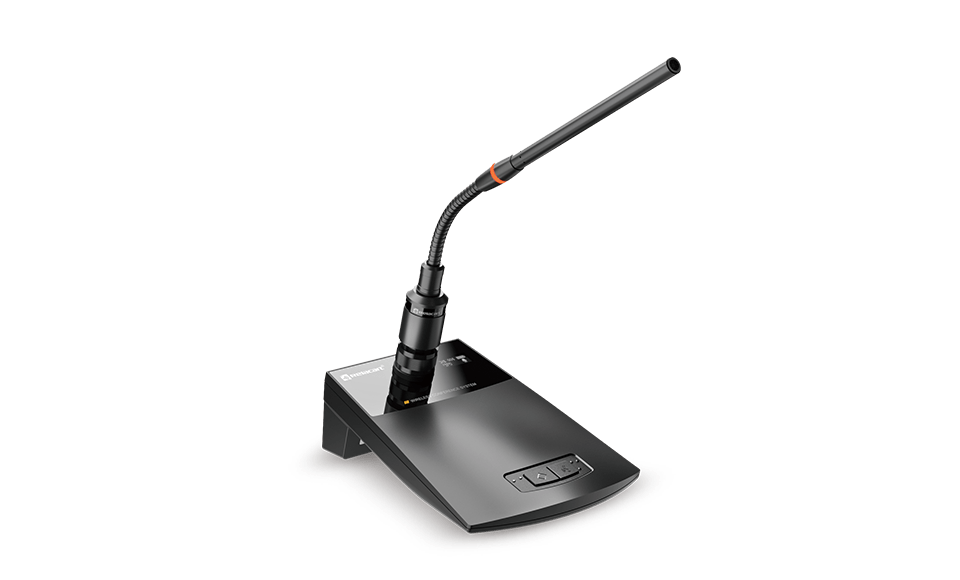
The CS-302 chairman unit's official numbers illustrate what "meeting-grade" means at the desk. Audio: 50 Hz-18 kHz response, sensitivity -30 dB (plus or minus 3 dB), maximum input sound pressure level 105 dB with distortion below 0.1% and signal-to-noise above 100 dBA - measurements chosen so a soft-spoken delegate and a banged podium both pass through clean.
Service details that matter in real chambers: the gooseneck is field-replaceable in three lengths (340, 420 or 480 mm) to suit desk depth and camera framing; the base is a compact 182 x 51 x 110 mm; the interconnect is an anti-drop 9-pin aviation plug rather than a fragile connector; and each unit weights about 950 grams - heavy enough to feel institutional, light enough to reconfigure the room for a hearing.
The 1.5 W maximum loudspeaker per unit is deliberate headroom for the request-to-speak workflow: the delegate hears the room through the unit until recognised, then the system manages who is live.
How Does the Wired Chain Integrate with Cameras and Recording?
The modern demand in government rooms is not just audio - it is the automatic pairing of "who is speaking" with "what the camera shows" and "what the archive keeps". A wired discussion chain contributes this natively, because every unit's state (active, requesting, off) is known to the host system in real time over the same cable that carries audio and power.
That is the design intent behind the control architecture our conference line documents in its connection diagrams: the host controller exposes delegate states to a camera-switching controller, which drives PTZ camera presets per seat. Recording then receives a clean, gated signal per delegate rather than an open room feed. The same pattern extends to wireless chains - the WDC-903 main frame connects to camera-switching hardware over its control network - which is why hybrid rooms are increasingly the default rather than the exception.
When Does a Government Room Still Need Wireless?
Two situations, both common. Heritage and protected buildings where cabling a chamber is politically impossible: the WDC-903 carries six channels per 1U main frame over 521.25-936.85 MHz with 48 kHz / 24-bit sampling, working to about 80 metres in open space.
Multi-room and overflow use: the same chamber hosts committee sessions in annex rooms, or delegates join from a side room. The WDC-903's units run 23 hours per charge (48 hours standby) on Li-ion cells with 15 mW RF output - a day of sittings per battery, no cabling, and a frequency plan instead of a cable plan. The trade is deliberate and documented in our wired vs wireless comparison.
Chamber decision table: wired CS-302 chain vs wireless WDC-903 chain
| Requirement | Wired (CS-302) | Wireless (WDC-903) |
|---|
| Per-unit power | 24 V DC from host - none on the desk | Li-ion, 23 h per charge / 48 h standby |
| Session reliability | Deterministic, no spectrum dependency | Requires a frequency plan and site check |
| Room reconfiguration | Fixed seat positions | Anywhere within ~80 m open-space range |
| Camera / recording integration | Native via host controller | Native via main frame control network |
| Best fit | Permanent chamber, weekly sittings | Heritage rooms, annexes, multi-room use |
What Does a Real Head-of-Delegation Installation Look Like?
A published reference: the international infrastructure investment and construction forum installation, documented with photographs on our case pages, put discussion units in front of head-of-delegation seating across a multi-day summit programme - the round-table geometry, per-seat goosenecks and host-managed speaking order that government chambers standardise on, at head-of-state protocol level.