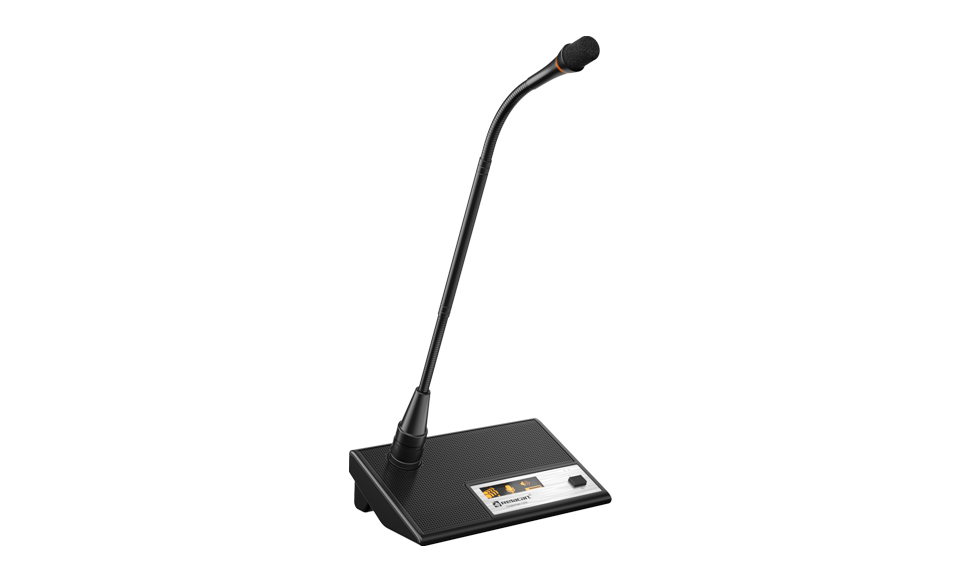
A CS-302 series delegate unit - the endpoint of a daisy-chained bus whose health depends on power budget, terminators and grounding.
Wired conference discussion systems are the most dependable part of a meeting room: no RF environment, no battery anxiety, a bus topology that has worked the same way for decades. Which is why, when one does misbehave, the room assumes something is broken - when in practice the fault lives in a handful of well-known places: the power budget of the bus, a terminator, a grounding point, or a configuration menu.
This is a field guide organised by symptom, not by product. It applies to the CS-series wired discussion family - central unit, chairman and delegate units daisy-chained by locking aviation cable or twisted pair - and to most bus-wired discussion systems generally, since the failure modes barely change between brands of bus. For the room-level architecture, start with what a conference discussion system is. The failure list comes from support practice across hundreds of installations, from village committee rooms to command centres running our CS-302 series with video tracking. If you are still choosing between wired and wireless, our comparison guide covers that first; this article assumes the wire is already in the floor.
Thirty Seconds of Architecture, So the Faults Make Sense
A wired discussion system is a powered bus. The central controller hosts the audio processing and system logic; chairman and delegate units hang off it in a daisy chain, each unit passing power and signal to the next. On the CS-302 platform, one central unit powers up to 40 microphone units, extending to 110 units with an additional power supply. Units connect by locking aviation connectors or by twisted pair through RJ45 ports, and the central unit provides balanced XLR and 6.3 mm outputs plus RCA line inputs and outputs for the rest of the sound system.
Four working modes sit on top of the bus - FIFO (first-request-first-served), time-limited speech, request-to-speak, and voice activation (VOX) - and a chairman unit holds priority over delegates. Higher-spec configurations add a video-tracking channel: the CS-302 drives up to four cameras over RS-232 or RS-422 using VISCA, PELCO-D or PELCO-P protocols, with four video inputs and one output supporting SD and HD-SDI.
Every fault below is a failure of one of these layers: power, bus integrity, grounding, mode configuration or the video link.
The Eight Faults, by Symptom
- 1. Units past the middle of the table go dark — A failed or half-seated unit mid-chain breaks power and signal to everything after it. Isolate by segment: split the chain and reconnect section by section until the fault point shows itself. On long lines, first check connector contact, then add an auxiliary power supply - a bus at the end of its power budget dims gradually before it dies.
- 2. Units get "garbage" IDs or are skipped during scan — Install the terminator at the end of the bus - it prevents signal reflection, which is what corrupts identification. Then align firmware versions across all units, power-cycle the central unit, and re-run the scan and numbering. Mixed firmware generations are the classic hidden cause.
- 3. No communication over a long line — When the bus exceeds roughly 50 metres or 15 units on a single supply, power runs out before the last seat. Check and replace the connecting cable, verify IP settings, and install the auxiliary power supply. If addressing conflicts appeared alongside, assign IPs manually rather than letting auto-assignment collide.
- 4. Hum and AC buzz in every microphone — A grounding problem, almost always. Ground the central unit at a single point, leave the bus shield floating at the far end (grounding both ends creates a ground loop - the direct cause of the hum), and separate power and signal cabling. The usual accomplice is the supply cable of a large LED screen sharing the same trunk as the bus - remove the interference source, and the buzz goes with it.
- 5. Distorted or overloaded sound from the system output — The central unit's line output is a line level, not a microphone level. Connect it to the mixer's LINE input, never the MIC input - a mic input adds gain on top of an already-amplified signal, and the distortion is baked in from the first patch.
- 6. Howling between microphones and loudspeakers — Feedback is geometry and gain, not a fault in the units. Limit the maximum number of simultaneously open microphones - most feedback builds from two open mics hearing the same loudspeaker - adjust loudspeaker placement so output does not point at capsule positions, and reduce system gain. On systems with automatic mixing, the open-mic limit is set per meeting in the mode menu.
- 7. Chairman priority does not override delegates — First confirm the active speech mode actually supports forced muting - not every mode does. Then verify communication with the delegate units and the permission settings; priority fails silently when the chairman unit cannot reach the units it is supposed to mute.
- 8. VOX mode opens microphones on its own — Voice activation is threshold-based, so a noisy room (HVAC, audience, paper rustle) crosses the threshold for you. Raise the VOX activation threshold, or switch to manual or request-to-speak mode for that room. False triggers are an environment problem, not a defective unit.
The Video-Tracking Layer: When Cameras Refuse to Follow
Video tracking faults feel mysterious because they cross two systems. The diagnosis is mechanical: confirm the control protocol matches on both ends - VISCA, PELCO-D or PELCO-P - and that the baud rate is identical on the central unit and the camera. Then load camera presets so the tracker has positions to command. A tracker with mismatched baud is not broken; it is speaking a different speed than the camera it is addressing.
The same discipline applies to central-control integration: the RS-232 port expects the control system's parameters to match its own. Half of all "the system stopped tracking" calls end at a serial parameter, not at hardware.
Prevention: Three Rules That Avoid Most of the List
Power budget first. Count units, measure the run, and decide the auxiliary power supply position before the carpet goes down - rules of thumb: roughly 50 metres or 15 units per supply stage, expand to 110 units on the CS-302 platform with the repeater supply. Budget for expansion now, because adding a power supply later means lifting the floor.
Terminator always. The end of the bus gets a terminator, unconditionally - it is the cheapest component in the system and the difference between clean scanning and garbage IDs. Related: keep firmware versions uniform across units, because mixed versions reintroduce scan problems on systems that worked for months.
Grounding once. One grounding point at the central unit, shield floating at the far end, power and signal cables separated in the trunk. Ground loops are invisible at commissioning and appear the first time the LED wall is switched on during a meeting.

A chairman unit from the CS-102 series: same bus, same rules - power budget, terminator and one grounding point.
How many microphone units can one central controller handle?
On the CS-302 platform, up to 40 microphone units per central unit, extendable to 110 units with an additional power supply. The practical limit on any given installation is usually the bus power budget over distance, not the unit count itself.
Why does the bus need a terminator?
A daisy-chained bus reflects signals from its open end, and those reflections corrupt unit identification and scanning. The terminator absorbs the signal at the end of the line, preventing reflection-related ID errors and unstable communication.
When should a wired system be replaced by a wireless discussion system?
When the room cannot accept fixed cabling, when units must move between rooms, or when tables are reconfigured frequently. Wired buses remain the most dependable and lowest-maintenance choice for fixed seating; our wired-vs-wireless guide walks through the decision by room type.


