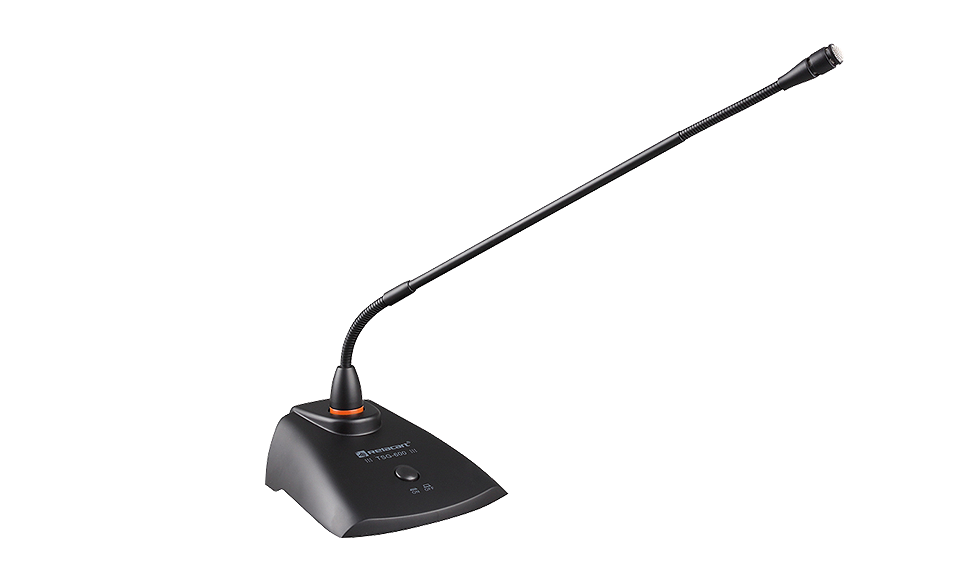
TSG-600 wired gooseneck conference microphone (product image: relacart.com)
Most meeting-room microphone problems are not microphone problems at all — they are placement and selection problems. A gooseneck microphone desk stand solves both at once: it fixes the capsule at a repeatable distance from the speaker’s mouth, keeps the table clean, and turns one microphone into a permanent, predictable part of the room. This guide walks through how to choose one: wired or wireless base, which specifications actually matter, and which form factor fits which room.
The answer in one line: if the table has cabling infrastructure, choose a wired gooseneck desk stand such as the TSG-600; if the room is protected, multi-purpose, or reconfigured often, choose a wireless desk stand such as the UD-222; if the table furniture is custom millwork, embed the microphone with a unit like the BM-113. The sections below justify each choice with real specifications from Relacart’s conference range.
What a gooseneck desk stand actually is
A gooseneck desk stand is three parts working together: a condenser capsule, a stiff-but-formable gooseneck tube, and a base that either connects by wire or carries a radio transmitter. The tube holds the capsule 30 to 50 centimetres in front of the speaker and, because it stays where you bend it, every speaker gets the same working distance — which is exactly what automatic mixers and voice-lift DSP need in order to behave predictably.
Relacart’s TSG-600 is a representative wired unit: a cardioid condenser capsule on a 420 mm rigid tube, mounted on a low-profile base with a three-mode mute switch and LED indicator. The small-diameter tube uses a rotatable ball joint, so the capsule angle can be adjusted once and then stays put — one of the reasons the model is specified for courtrooms, council chambers, government halls, schools and churches, where the microphone must sit quietly on the desk and never drift.
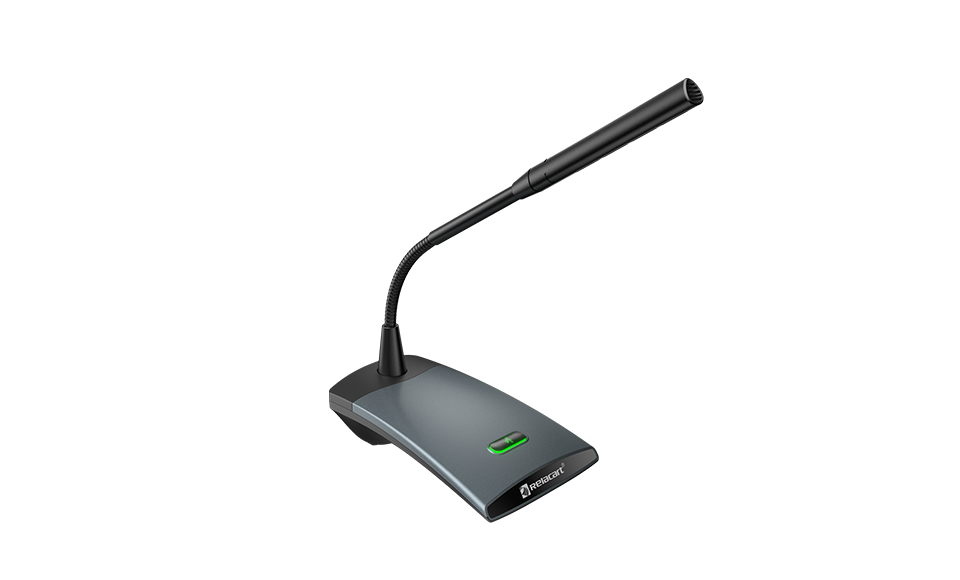
TSG-560 wired gooseneck conference microphone (product image: relacart.com)
Wired base or wireless base?
A wired base is the default when the room has floor boxes, table ports or a fixed discussion layout. The TSG-600 draws only about 5 mA from an 11–52 V phantom supply and outputs on a built-in 3-pin XLR male connector, so it plugs straight into any standard microphone input — no batteries to manage, no radio spectrum to coordinate, and a signal path that stays identical for the life of the installation.
A wireless desk stand earns its place when cabling is impossible or the room changes layout. The UD-222 packs a PLL-synthesised transmitter into a metal desktop base with a high-contrast OLED display: carrier band 470–936.85 MHz (set per region), RF power switchable between 20 mW and 2 mW, a low-cut switch below 200 Hz, and volume adjustment from −10 to +10 dB. Two AA cells run it for more than eight hours, which covers a full meeting day without a mid-session battery change.
The choice is practical, not ideological. Wireless adds frequency coordination and a battery routine; wired adds cable paths and fixed furniture. Rooms that mix both — say, a wired podium plus wireless units for flexible tables — work fine as long as both share one coherent frequency plan.
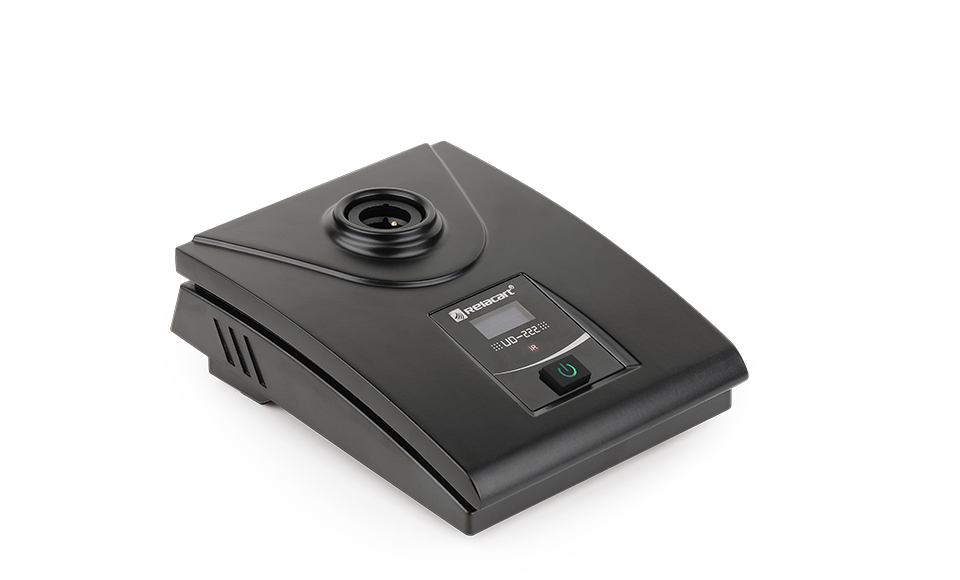
UD-222 wireless gooseneck microphone desk stand (product image: relacart.com)
The specs that actually matter
Datasheets list dozens of numbers; five of them decide whether a gooseneck desk stand will sound right in your room.
One more number deserves attention on wireless bases: current draw. The UD-222 consumes a typical 130 mA — modest enough that two AA cells genuinely deliver the promised eight-plus hours, not just a laboratory figure.
Table 1 — Five specifications worth checking before you buy
| Specification | What to look for | In the Relacart range |
|---|
| Pickup pattern | Cardioid, to reject reflections and side noise | Cardioid condenser across TSG-600, TSG-300, GS-530 and BM-113 |
| Frequency response | Full speech band, not just telephone quality | 80 Hz–18 kHz (TSG-600, TSG-300); 35 Hz–18 kHz (GS-530, BM-113) |
| Maximum SPL | At least 130 dB so a raised voice never distorts | 133 dB (TSG-600, TSG-300); 130 dB (GS-530, BM-113) |
| High-pass filter | Rolls off rumble below the voice band | 100 Hz at 18 dB/octave (GS-530, BM-113); low-cut below 200 Hz (UD-222) |
| Power | Phantom for wired; battery life for wireless | TSG-600: DC 11–52 V, about 5 mA; UD-222: 2 × AA, over 8 hours |
Matching the form factor to the room
The same capsule technology comes in four desk-level form factors, and the room usually makes the decision before the budget does.
The BM-113 deserves a second look for video-conference rooms: it mounts to low ceilings or furniture with a short flexible gooseneck, terminates on a standard electrical box behind a 1G panel, and carries RF shielding that keeps nearby mobile phones from feeding noise into the audio path. That shielding philosophy runs through the whole family — useful in rooms where phones will never be banned, only tolerated.
Table 2 — Which form factor for which room
| Room / situation | Form factor | Example |
|---|
| Fixed board table with floor boxes or table ports | Wired gooseneck desk stand, XLR output | TSG-600 |
| Council chamber or courtroom — mute discipline matters | Wired gooseneck with three-mode mute switch and LED | TSG-600 |
| Protected or multi-purpose room, frequent reconfiguration | Wireless gooseneck desk stand | UD-222, UD-223 |
| Custom millwork or flush furniture | Embedded gooseneck for ceiling or panel mounting | BM-113 |
| Podium, lectern and lecture capture | Long gooseneck with switchable high-pass filter | GS-530 (530 mm tube) |
Deployment details that decide the result
None of these details is difficult; each one is simply cheaper to decide before the furniture is ordered than after.
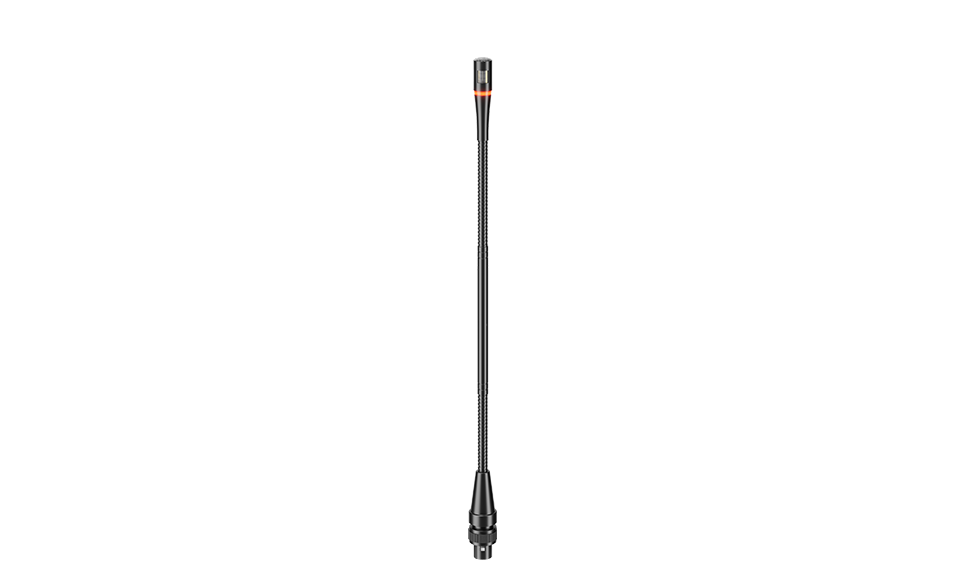
Gooseneck tube and capsule detail (product image: relacart.com)
- Keep the working distance consistent — for the GS-530 capsule the optimal pickup distance is 10–20 cm; brief every user rather than relying on them to guess.
- Bend the tube once, at installation. The ball joint on the TSG-600 holds its position; re-bending it daily eventually loosens any gooseneck.
- Enable the high-pass filter in rooms with air conditioning: 100 Hz at 18 dB/octave on the GS-530 and BM-113, or the 200 Hz low-cut on the UD-222 base.
- On wireless bases, use the 2 mW RF power setting whenever the receiver is in the same room — the 20 mW setting is for longer distances, and less radiated power makes frequency coordination easier.
- For embedded installations, confirm the phantom budget early: the BM-113 needs DC 24–52 V at about 20 mA, which not every wall-panel power supply provides.
Frequently asked questions
What is a gooseneck microphone desk stand?
A desktop microphone that combines a cardioid condenser capsule, a formable gooseneck tube and a base — wired with an XLR output (TSG-600, TSG-300) or wireless with a built-in PLL transmitter (UD-222, UD-223). The tube holds the capsule at a fixed working distance in front of the speaker, which keeps pickup level consistent from seat to seat.
How far should the gooseneck capsule sit from the speaker’s mouth?
For the GS-530 capsule, the optimal pickup distance is 10–20 cm. Longer tubes reach further across a table, but the capsule should still land inside that band — distance, not gain, is what keeps the signal clean.
Do gooseneck desk stands need phantom power?
Wired models do: the TSG-600 and TSG-300 run on DC 11–52 V phantom at roughly 5 mA from any standard microphone input, while the BM-113 needs 24–52 V at about 20 mA. Wireless bases such as the UD-222 need none — they run on two AA batteries for more than eight hours.
Can a gooseneck microphone reject air-conditioning noise?
It helps in two ways: the cardioid pattern rejects sound from the sides and rear, and switchable high-pass filters remove low-frequency rumble — 100 Hz with an 18 dB/octave slope on the GS-530 and BM-113, and a low-cut below 200 Hz on the UD-222 base. Neither replaces sensible HVAC zoning, but together they handle typical office noise.
Wired or wireless desk stand — which should I buy?
Follow the room, not the trend. Fixed furniture with table ports favours wired (TSG-600); protected interiors, shared rooms and frequent reconfiguration favour wireless (UD-222, UD-223); custom millwork favours embedded (BM-113). Many installations end up mixing two form factors under one coherent plan.