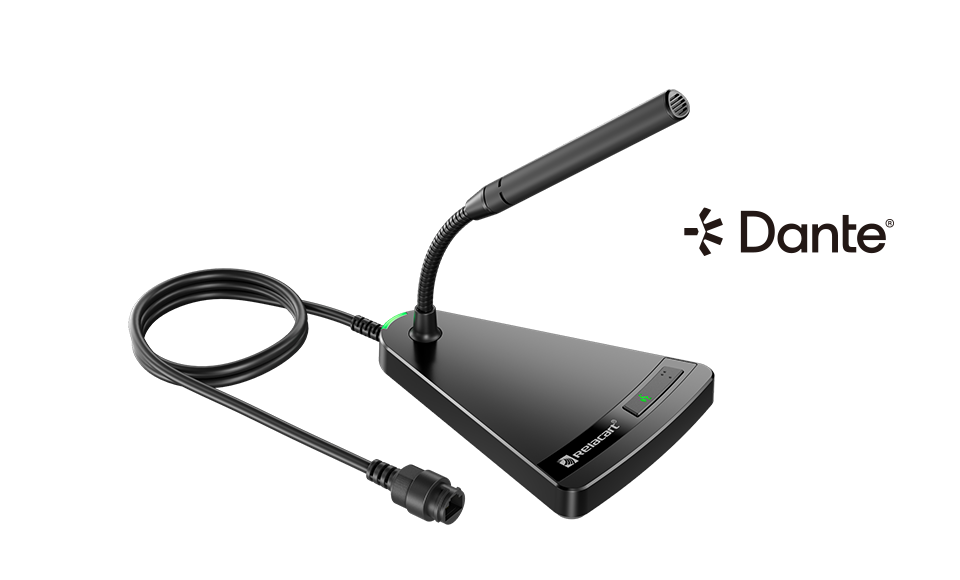
Relacart TDN3 Dante conference microphone with triangular gooseneck
Dante replaces the analogue snake that used to run between a conference table and the equipment rack with a single network cable. One Cat5e or Cat6 cable per device now carries audio, control and — in most cases — power.
Relacart has been part of that shift since 2015, when it became one of the first manufacturers in China to adopt Dante technology and shipped the TDN1, its first Dante microphone. This guide explains what Dante actually changes in a conference room, and what to check before specifying it.
What Dante Changes in a Conference Room
In a conventional room, every microphone needs its own analogue cable back to the mixer, and every channel needs gain staging, balancing and a physical input. Dante moves that traffic onto a standard IP network: audio travels as uncompressed 48 kHz, 24-bit streams between devices that discover each other on the network.
The practical consequences are fewer cables, easier expansion, and the ability to route any microphone to any processing device without repatching.
Power and Data on One Cable
Most Dante conference devices draw power over the same Ethernet cable that carries their audio. The Relacart TDN1 and TDN3 desk microphones are powered to the IEEE 802.3af PoE standard and consume 2.3 W each; the ACM-582 ceiling array microphone runs on PoE or PoE+ with a 3 W maximum.
A network switch that supplies PoE therefore replaces both the power supply and the audio multicore. Cable runs follow normal Ethernet rules — Cat5e or better, with shielded cable recommended for ceiling installations such as the ACM-582.
The Building Blocks of a Dante Conference Room
Table 1 — Relacart Dante building blocks
| Building block | Relacart example | What it contributes |
|---|
| Dante desk microphone | TDN1, TDN3 | 20 Hz–20 kHz pickup, PoE powered, XLR capsule socket (TDN1) or fixed gooseneck (TDN3) |
| Automatic mixing | CONFER X; DAM-128D, DAM-208D | 64-channel digital intelligent mixing with Dante I/O; 12- and 20-channel Dante automatic mixers for smaller rooms |
| Wireless with Dante output | UR-D2, UR-2Q | Digital wireless systems whose audio lands directly on the Dante network |
| Ceiling array microphone | ACM-582 | Five MEMS elements, 7.6 × 7.6 m coverage, one Dante/AES67 channel at 48 kHz, 24-bit |
TDN1 and TDN3: Two Ways to Put a Microphone on the Network
The TDN1 is a desktop base that takes any gooseneck capsule with a 3-pin XLR termination. It provides 48 V phantom power to the capsule, six gain steps, a 150 Hz low-cut filter at 18 dB per octave and a 65 dB signal-to-noise ratio at 1 kHz, 1 Pa, and connects over standard Cat5 or Cat6 at 100 Mbps or better.
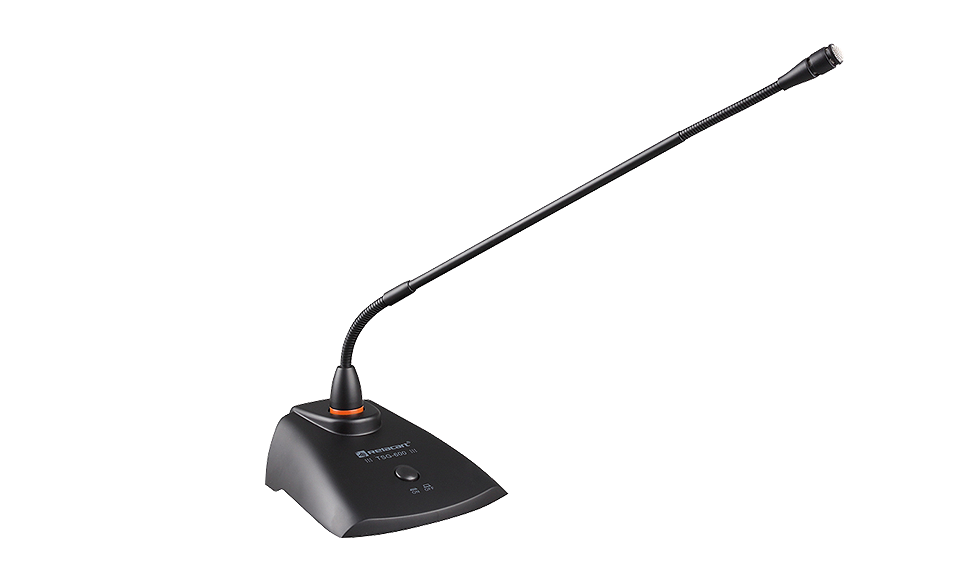
The TDN3 is a fixed-gooseneck unit for rooms that want a finished product rather than a capsule choice. It adds TDM software control — IP address visibility, per-microphone tone, equalisation, LED colour and level, all copyable between units — a four-band parametric equaliser, and a one-key fault location function that blinks the LED of the microphone being diagnosed.
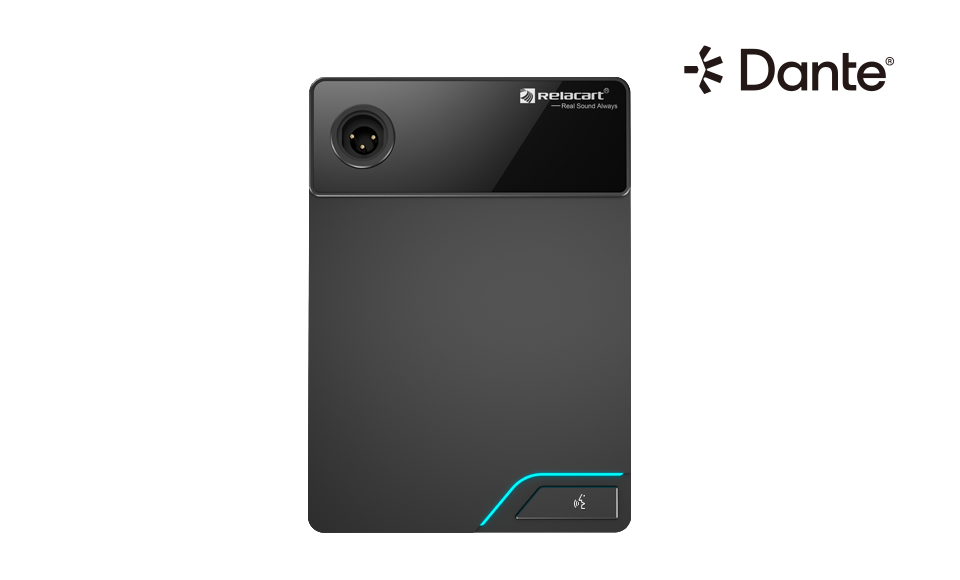
Relacart TDN1 Dante desk microphone base: 3-pin XLR capsule socket, powered over PoE
Automatic Mixing: Where Dante Earns Its Keep
Open microphones are the enemy of intelligibility in meeting rooms. Automatic mixing addresses it by activating only the channels that carry speech. Relacart’s CONFER X is a 64-channel digital intelligent mixer with Dante connectivity — and, per the company’s own record, the world’s first Dante automatic intelligent mixing system when it appeared in 2019.
For smaller rooms, the DAM-128D and DAM-208D provide 12- and 20-channel digital automatic mixing with Dante interfaces.
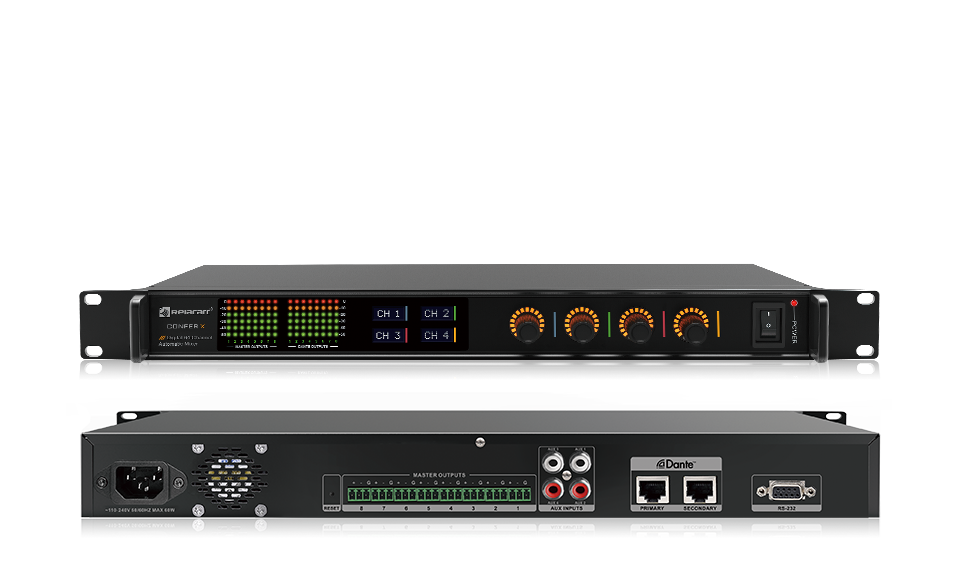
Relacart CONFER X 64-channel intelligent mixer; the Dante ports are on the rear panel
Bringing Wireless into a Dante Room
A conference room that also needs roaming microphones can keep its wireless on the same network. Relacart’s UR-D2 dual-channel digital wireless system has a Dante output that auto-identifies its Dante channels, and the UR-2Q four-channel true-diversity system carries the same output in a 130 MHz switching bandwidth.
The result is one audio backbone: wired table microphones, ceiling arrays and wireless handhelds all appear as Dante sources, and the DSP or amplifier picks them up without analogue conversion.
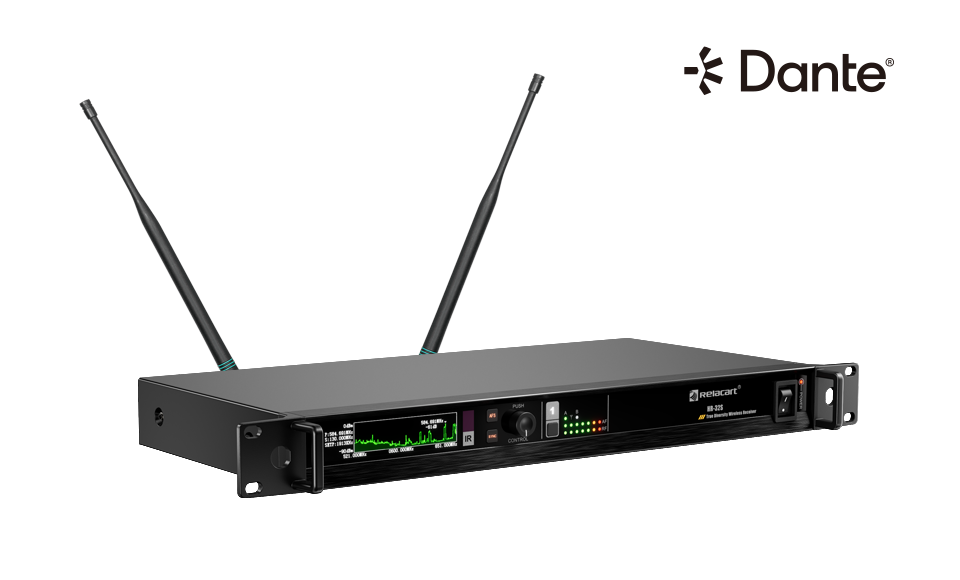
Relacart digital wireless receiver with Dante audio output
Deployment Notes
- Confirm that the network switch supplies PoE on the ports you plan to use — the TDN1 and TDN3 draw 2.3 W each, and the ACM-582 up to 3 W.
- Use Cat5e or better; shielded cable is recommended for ceiling microphone runs such as the ACM-582.
- Plan the Dante network across two separated switches (primary and secondary) if redundancy matters.
- Count open microphones, not seats: the automatic mixer’s channel count is what buys intelligibility.
- Keep wireless and wired sources on the same Dante domain so any source can be routed anywhere.
- Leave switch capacity for a second ceiling array before committing to a single unit.
Frequently Asked Questions
Does a Dante microphone still need a mixer?
It needs something to receive and process its audio, but not necessarily an analogue mixer. A Dante-enabled DSP, amplifier or automatic mixer such as the CONFER X receives the channels directly over the network.
How is a Dante microphone powered?
Over the same Ethernet cable that carries its audio. The TDN1 and TDN3 use IEEE 802.3af PoE at 2.3 W; the ACM-582 ceiling array accepts PoE or PoE+ up to 3 W.
What sample rate and bit depth does Dante carry?
Relacart’s ACM-582 outputs one Dante or AES67 channel at 48 kHz, 24-bit. Networked audio devices negotiate this per channel.
Can Dante and analogue microphones coexist?
Yes. Analogue sources can enter through a Dante interface or a mixer’s Dante card, so a room can migrate microphone by microphone.
Which Relacart wireless systems output Dante?
The UR-D2 dual-channel and UR-2Q four-channel digital wireless systems both provide Dante network audio output.