On August 19, at the Beijing International Radio, TV & Film Exhibition (BIRTV), a quiet revolution concerning the future direction of wireless audio was taking place. At the Relacart booth, I did not see an abundance of flashy technological demonstrations. Instead, what stood out was a technical landscape built around three major digital wireless microphone series: EZD.Mi, UR-D, and BG-24.
With questions about the evolution of digital wireless technology in mind, DAV Digital Audio-Visual Engineering Network conducted an on-site interview with Mr. Wu Tingfei, Wireless Audio Engineer at Relacart. From the perspectives of technical architecture, spectrum strategy, and AI integration, the interview sought to explore how this Chinese brand, backed by more than 30 years of RF technology expertise, is building its own technological moat amid this far-reaching transformation of the industry.

Three Technical Architectures Advancing in Parallel: Beyond Scenario Segmentation to a Reconstruction of the Underlying Logic
“These three products are not simply positioned as low-, mid-, and high-price options. They represent three fundamentally different technical architectures and application philosophies.” When asked how the EZD.Mi, UR-D, and BG-24 series are positioned, Wu Tingfei immediately corrected a common misunderstanding in the market.
In Relacart’s technical philosophy, the application scenario defines the product, while the technical architecture determines the product’s ability to perform and survive in a specific scenario.
First is the EZD.Mi series, positioned as a “pioneer in popularizing digital wireless.” Wu Tingfei explained that the series includes single-, dual-, and four-channel models. Its core mission is to address long-standing pain points in entry-level and small- to medium-sized applications, such as small meeting rooms, roadshows, and livestreaming: achieving stable signal transmission within a limited budget.
“EZD.Mi adopts a highly integrated digital modulation architecture. Its original design objective was not to pursue the ultimate dynamic range, but rather to use digital algorithms for frequency hopping and error correction in complex and congested 2.4G or U-band environments, ensuring speech continuity and clarity. It represents a decisive advantage over traditional low-cost analog microphones, which are prone to interference and frequent signal dropouts.”
The UR-D series, the flagship highlight of this exhibition, represents Relacart’s highest achievement in digital RF technology. According to Wu Tingfei, the UR-D series is designed for demanding applications such as broadcast-grade large-scale performances and important government conferences. Its technical core lies in the proprietary FBGAA (Dynamic Feedback Gain Array Architecture) algorithm.
Unlike EZD.Mi, UR-D features a higher-sensitivity low-noise amplifier in its RF front end and uses a high-performance FPGA for real-time digital predistortion (DPD) processing. The value of this architecture lies in its ability to perform inverse compensation in the digital domain when large amounts of intermodulation interference and adjacent-channel interference are present, significantly improving the in-band signal-to-noise ratio and thereby “squeezing” more usable channels into extremely narrow gaps in the spectrum.
As for the BG-24 series, it is a differentiated product with a highly strategic perspective. It moves beyond the traditionally congested U-band and operates in the globally license-free 2.4 GHz ISM band.
“This is not simply a change of frequency band, but a redesign of the technical architecture,” Wu Tingfei emphasized. “Interference in the 2.4G band is more complex, including Wi-Fi and Bluetooth. Therefore, BG-24 integrates more sophisticated Adaptive Frequency Hopping (AFH) and Time Division Multiple Access (TDMA) technologies to ensure that it can still meet professional-grade requirements in an unlicensed frequency band.”
This positioning precisely meets overseas demand for license-free frequency bands, while also addressing the need for convenient deployment in domestic applications such as small-scale livestreaming and campus environments.
An Inevitable Choice Amid the Spectrum Crisis: Digital Wireless Is Not the Better Solution, but the Only Solution
When asked whether digital wireless and analog wireless currently represent a replacement relationship or a complementary relationship, Wu Tingfei offered an observation with strong industry insight:
“At present, they are complementary. But in the near future, when you have only a few megahertz of spectrum left available, they will become substitutes for one another.”
This judgment points directly to the “Sword of Damocles” hanging over the wireless audio industry: spectrum contraction.
As the 700 MHz and 800 MHz bands have gradually been reallocated to telecommunications operators, the U-band spectrum available for professional audio has sharply decreased from several hundred megahertz in the past to only several tens of megahertz today.
During the interview, Wu Tingfei also shared a real-world test case at CCTV:
“At China Media Group, the tunable frequency window left for wireless microphones is often only around ten to twenty megahertz. Under such physical constraints, analog wireless microphones require relatively wide spacing between adjacent frequency bands, so usually only a dozen or so systems can be used simultaneously. Digital wireless microphones, however, occupy narrower carrier bandwidth and have excellent intermodulation avoidance capabilities, allowing the same spectrum range to accommodate several times as many channels.”
Regarding the debate over sound quality, Wu Tingfei offered a more rational technical analysis from an engineer’s perspective. He pointed out that analog systems are limited by the physical characteristics of electronic components, such as the thermal noise of resistors and capacitors, meaning there is a physical ceiling to how low the noise floor can be. Digital systems, by contrast, depend primarily on sampling rate and algorithms for sound quality, provided that a stable bit error rate (BER) can be maintained.
More importantly, digital systems have opened the door to encryption, which has become an essential requirement.
“In the past, high-end confidential meeting rooms did not dare use wireless microphones because analog signals were too easy to intercept,” Wu Tingfei explained.
He revealed that the Relacart UR-D series is already equipped with both the international AES-256 Advanced Encryption Standard and the SM4.0 national commercial cryptographic algorithm certified by China’s National Cryptography Administration.
“Encryption at this level gives wireless systems the security attributes of wired systems. This is an entirely new dimension of value that digital transformation has brought to the industry.”
AI Is Not Magic: It Is the Continuous Evolution of Algorithms and a Trade-Off with Latency
As AI technology sweeps across the audio-visual industry, Relacart has not blindly followed the trend. Instead, it has demonstrated a highly pragmatic approach to applying the technology.
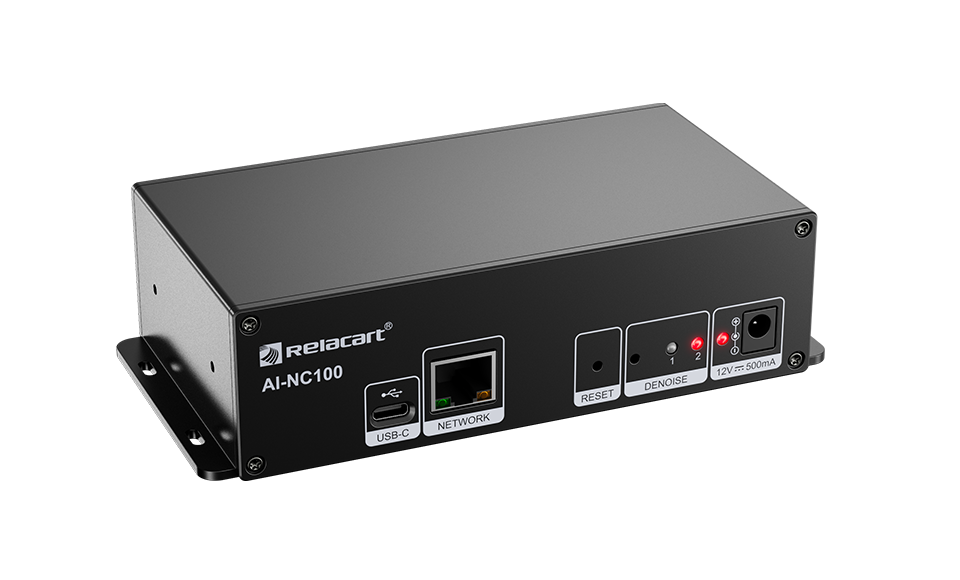
At the Relacart booth, AI technology was embedded within microphone arrays and audio processing boxes, focusing on solving the three pain points that most directly affect the listening experience: “noise reduction,” “feedback suppression,” and “echo cancellation.”
“We define AI as a nonlinear adaptive algorithm. The biggest difference between it and traditional DSP is that traditional algorithms are fixed. For example, you set a threshold, and anything above that threshold is cut. AI models, however, go through countless scenarios of ‘competition’ and ‘learning,’ enabling them to dynamically identify what is environmental noise and what is the main speaker’s voice, and then perform more refined level-based processing.”
Wu Tingfei gave an example. Early AI noise reduction could achieve a very clean result, but it lacked a sense of “atmosphere,” removing applause and environmental sounds together with the noise. Relacart’s current AI algorithm divides noise reduction into nine adjustable levels, from Level 1 to Level 9, allowing users to retain specific ambient sounds according to the application scenario. This is the more “human-centered” improvement brought about by iterative model development.
However, applying AI in audio is far from straightforward. The biggest obstacle is “latency.”
Wu Tingfei explained this technical bottleneck:
“The root cause of latency does not lie in RF transmission, but in the computation process. Adding one level of noise reduction algorithm increases latency by 0.5 milliseconds; adding one level of feedback suppression adds another 0.3 milliseconds. If large-model-based speech restoration and error correction are then added, the accumulated latency can reach a level perceptible to the human ear. In local sound reinforcement applications, that can be disastrous.”
Relacart’s current objective is to build an AI audio signal chain with total system latency of less than 10 milliseconds. This requires finding the optimal balance between algorithm optimization and computing platforms.
At present, Relacart is working with leading institutions including CCTV to explore large-model-based speech restoration technology. The aim is to use AI to compare and correct distorted signals against the original sampled signals, achieving “lossless-level” restoration of sound quality.
Once this technology achieves a breakthrough in latency control, it will fundamentally redefine the experience standards for remote conferencing and broadcast recording.

DAV Summary
At the end of the interview, when discussing expectations for the market in 2026, Wu Tingfei acknowledged that although the overall environment remains “cool” and project-side momentum is insufficient, Relacart still has substantial room to increase its market share across various market segments.
This is not blind optimism, but rather a clear understanding of the company’s own technological capabilities.
From the “democratization of technology” represented by EZD.Mi, to the “protection of national commercial cryptography” provided by UR-D, and then to the “global perspective” embodied by BG-24, Relacart is attempting to remove the label of “low price and low quality” from Chinese wireless microphones through a full-chain digital upgrade.