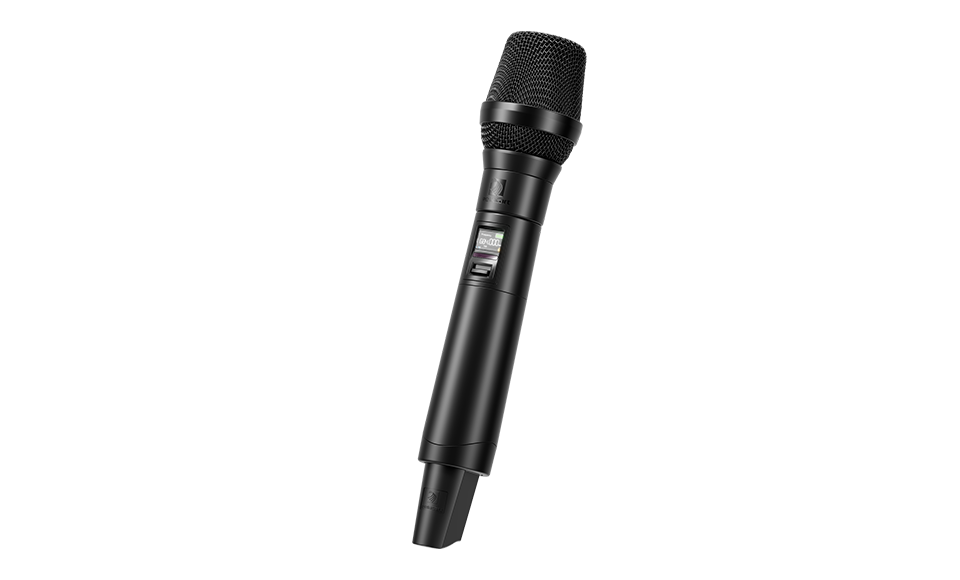
Relacart UH-D1 handheld transmitter, part of the UR-D digital wireless system
Both analog and digital wireless microphone systems put a microphone signal on a radio carrier. What differs is what happens to that signal between the transmitter and the receiver — and the difference shows up in dynamic range, latency, encryption and how many systems can share a room.
This guide compares the two on their own terms, using Relacart’s EU-610 analog true-diversity system and UR-D series digital systems as reference points. Neither is obsolete; they solve different problems.
What Each Technology Actually Does
An analog system frequency-modulates the carrier directly with the microphone signal and uses companding to squeeze the dynamic range through the channel. The EU-610 is a true-diversity FM superheterodyne receiver whose RF sensitivity is specified as a signal-to-noise ratio of at least 60 dB at 25 kHz deviation with a 5 dBv input; its transmitter spans a 128 MHz wideband range.
A digital system converts the audio to data first. Relacart’s UR-D1 and UR-D2 transmit 24-bit audio at a 48 kHz sampling rate, with total system latency under 3 ms, a dynamic range above 120 dB and a flat 20 Hz–20 kHz frequency response.
Side-by-Side Comparison
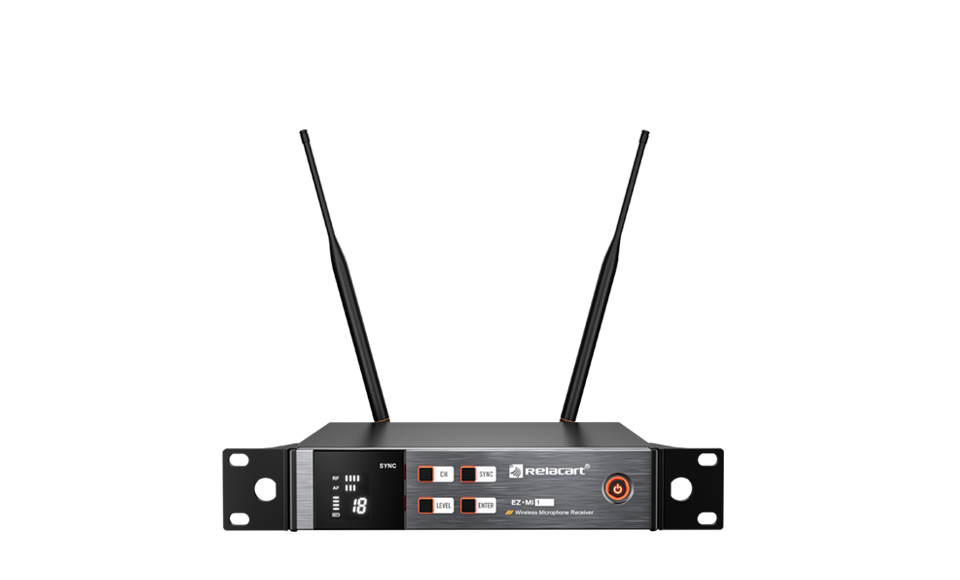
Relacart EZ-MI series receiver: true-diversity reception with 48 kHz DSP companding
Table 1 — Analog and digital UHF systems compared
| Factor | Analog (EU-610) | Digital (UR-D1 / UR-D2) |
|---|
| Signal path | FM modulation with companding | 24-bit / 48 kHz digital transmission |
| Dynamic range | Receiver S/N ≥60 dB at 25 kHz deviation | Over 120 dB |
| Latency | Direct analogue path, no codec delay | Under 3 ms, system total |
| Frequency response | Set by the companding scheme | Flat, 20 Hz–20 kHz |
| Encryption | Not available | AES-256 and SM4.0 on UR-D systems |
| Network audio output | Requires external conversion | Dante output on UR-D2 |
| Frequency efficiency | 128 MHz wideband transmitter; AFS search; 50 channel groups | 20 transmitters in an 8 MHz window; over 60 compatible channels per band |
Where Analog Still Wins
Analog remains a rational choice when the budget is fixed and the channel count is low. A true-diversity analog receiver such as the EU-610 already includes the tools that make multi-channel work manageable — AFS automatic frequency search, infrared synchronisation and 50 channel groups per band — so the frequency-management advantage of digital is smaller than it looks at two channels.
There is also no codec in the chain to configure, and troubleshooting uses the same RF reasoning that has applied to FM systems for decades.
Where Digital Wins
Dynamic range is the headline: above 120 dB on the UR-D series, against an analog figure constrained by the companding scheme. The audible consequence is a lower noise floor on quiet sources.
Encryption is digital-only. UR-D systems carry AES-256 and the SM4.0 national cryptographic standard, and the receiver accepts only encrypted signals — relevant wherever meeting content is confidential.
Frequency efficiency matters most in congested RF. Fitting 20 simultaneously operating transmitters into an 8 MHz window, and more than 60 compatible channels into one operating band, is what allows large multi-channel rigs to coexist.
Integration: the UR-D2’s Dante output lands wireless audio directly on the network, and WireMicX software provides remote monitoring and control.
Common Misconceptions
- Digital always means lower latency. Digital adds a codec, so latency is a design property; Relacart specifies under 3 ms total for the UR-D series, which is low — but it is not zero.
- Digital audio cannot be intercepted. Encryption is a separate feature. On UR-D systems it is AES-256 plus SM4.0; without it, a digital carrier is no more private than an analogue one.
- Analog is obsolete. A true-diversity analog receiver with AFS, IR sync and channel groups still delivers predictable, serviceable multi-channel operation.
- Digital eliminates interference. Interference is an RF problem; digital changes how a collision is heard — as a mute or a data error rather than a howl — not whether the frequency was clean.
Recommendation by Scenario
Table 2 — Which technology fits which room
| Scenario | Better fit | Relacart example |
|---|
| Confidential board or government meetings | Digital, for AES-256 + SM4.0 link encryption | UR-D1, UR-D2 |
| Rooms already running a Dante network | Digital, for native network audio | UR-D2 (Dante output) |
| Large multi-channel stage in congested RF | Digital, for frequency efficiency | UR-D1 / UR-D2, 64 MHz bandwidth |
| Cost-controlled two-microphone rooms | Analog true diversity | EU-610 |
| Multi-room AV with mixed handhelds and bodypacks | Either, matched within one platform | EZ.Mi series: EZ.Mi1 / Mi2 / Mi4 with EZ.B8 |
Frequently Asked Questions
Is a digital wireless microphone automatically better than analog?
No. It wins on dynamic range, encryption and frequency efficiency, but an analog true-diversity system with a good frequency plan still delivers predictable service at lower cost.
Does digital wireless have audible latency?
Relacart specifies total system latency under 3 ms for the UR-D series, which is below the level generally noticed on live speech.
Can analog and digital transmitters share a receiver?
No. The receiver must be built for the modulation it receives. Mixing happens at the console, not the receiver.
Which is more resistant to interference?
Neither changes the physics of RF. Digital changes the failure mode — a dropout instead of a howl — and its higher frequency efficiency makes clean frequency plans easier to build.
What does companding do to analog sound?
It compresses the dynamic range for transmission and expands it on reception. The EZ.Mi series reduces the artifacts with 48 kHz DSP companding; the residual noise floor is still higher than a 120 dB digital path.