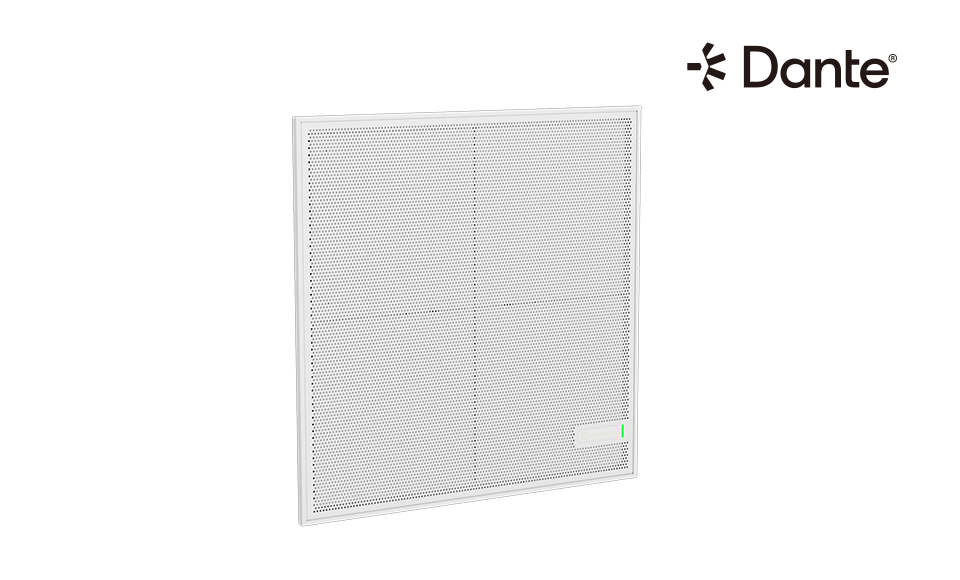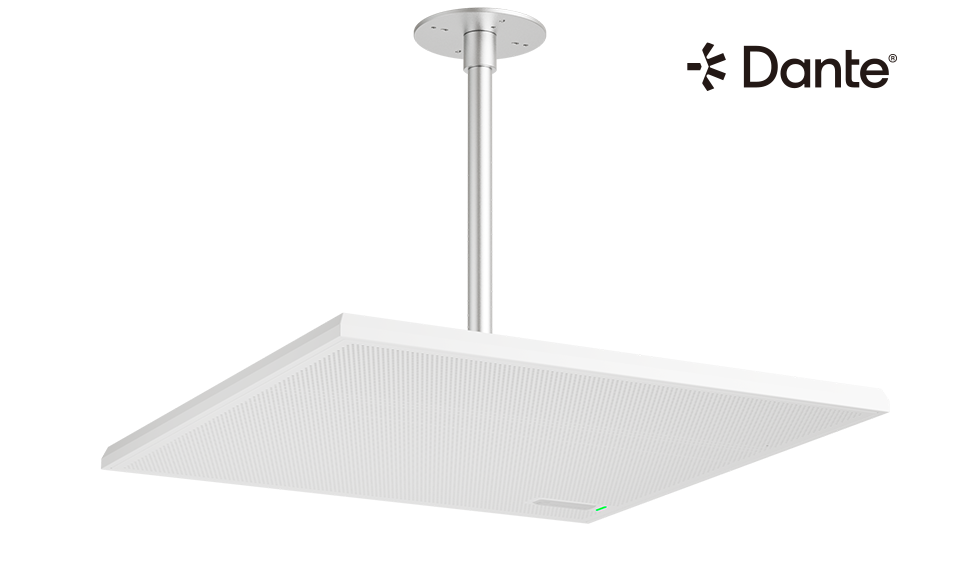
Relacart ACM-582 AI ceiling array microphone, suspended installation (product image: relacart.com)
Most disappointing conference room audio is not caused by bad microphones or bad speakers. It is caused by the room itself: sound bouncing off glass, drywall, and hard floors before it ever reaches a microphone. Traditional microphones capture that polluted sound faithfully — and every downstream device then amplifies the problem.
An AI ceiling microphone system attacks the problem at the point where the voice enters the signal chain. This article explains the four acoustic problems that ruin meeting audio, what AI-based processing actually does about each one, and how a ceiling array such as the Relacart ACM-582 fits into a professional conference system.
Why conference rooms are hard on microphones
Meeting rooms concentrate the worst conditions for voice capture in one space: multiple talkers at different distances, large reflective surfaces, HVAC noise, and loudspeakers playing in the same room as the microphones. In a well-treated studio these variables are engineered away. In a normal office, classroom, or hotel meeting room, they are simply there.
The result is a familiar list of complaints: voices sound distant and washed out, the system howls when someone talks too close to a loudspeaker, remote participants hear themselves echoed back, and constant background noise forces everyone to speak louder. Each of these has a distinct acoustic cause — and each can be addressed in the audio path.
The four problems, one by one
Ceiling microphone systems with built-in AI processing target four specific problems. Understanding what each one is makes the technology choices easier to evaluate.
- Reverberation — In rooms with hard surfaces, reflected sound arrives at the microphone after the direct sound, smearing consonants and making voices sound far away. The ratio of direct to reflected energy (Direct-to-Reverberant Ratio, DRR) is what makes a voice sound "close".
- Acoustic feedback — When a microphone picks up sound from the room loudspeakers and that sound is re-amplified, a loop forms. Once the loop gain exceeds unity at some frequency, the system produces the familiar howl — narrowband feedback.
- Echo on calls — In video conferences, the far-end voice played through local loudspeakers is picked up by the microphones and sent back. Without acoustic echo cancellation (AEC), remote participants hear their own words repeated.
- Background noise — Projector fans, HVAC, traffic, and keyboard noise sit under the speech and force talkers to raise their voices. Effective noise reduction must remove it on both the uplink (to remote participants) and the downlink (in the room).
What the AI processing actually does
The Relacart ACM-582 processes the audio it captures with four AI-based functions, described in the manufacturer’s product documentation as follows.
Intelligent de-reverberation uses deep neural networks (DNN) trained to separate direct voice from reflected energy, improving the Direct-to-Reverberant Ratio so speech sounds closer and cleaner even in reflective spaces such as halls with hard walls. Dynamic feedback suppression uses an integrated AI processor to identify and suppress narrowband feedback between loudspeakers and microphones before it saturates the output. Full-duplex acoustic echo cancellation removes echoes even while both parties are speaking at the same time, and is designed to work in low signal-to-noise environments without relying on special mechanical design. Finally, 360° AI noise reduction removes background noise on both uplink and downlink paths while preserving voice clarity.
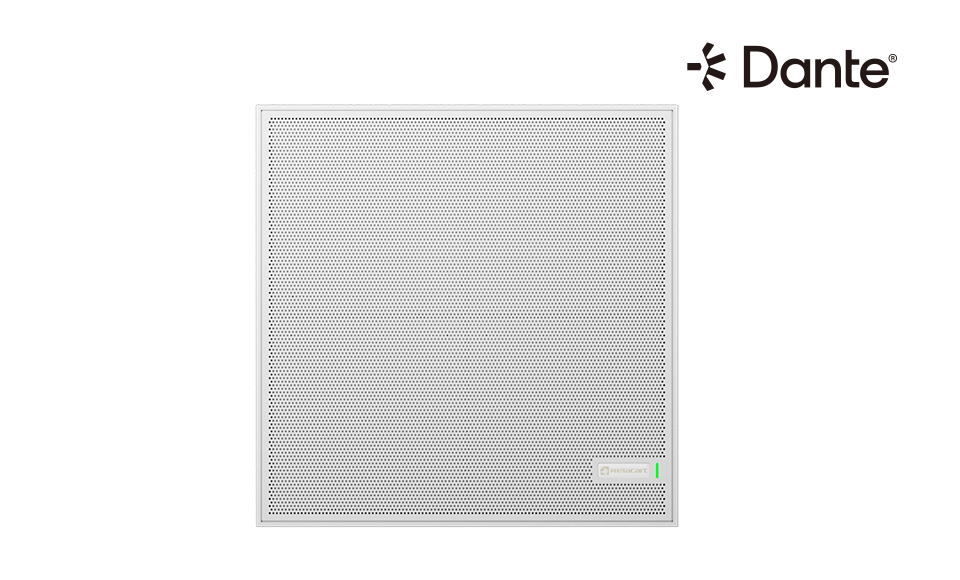
ACM-582 flush (concealed) ceiling installation view (product image: relacart.com)
The signal chain: from ceiling to amplifier
A ceiling array microphone is a network device, not a standalone gadget. The ACM-582 connects to the room’s network with a single Cat5e or higher cable (shielded recommended) that carries both power — PoE/PoE+ per IEEE 802.3af/at, maximum 3 W — and audio. Its output is one Dante/AES67 channel at 48 kHz / 24-bit, which lands on the DSP or mixer like any other network audio stream and can be routed with Dante Controller.
From there the signal follows the normal professional path: DSP or automatic mixer, then amplifier and loudspeakers. Because the microphone output is already cleaned of reverberation, echo, and noise, the downstream processing starts from a much healthier signal. Setup and monitoring are handled in the browser-based TDM software, which covers EQ, gain, high-pass filtering, mute, and LED indication.
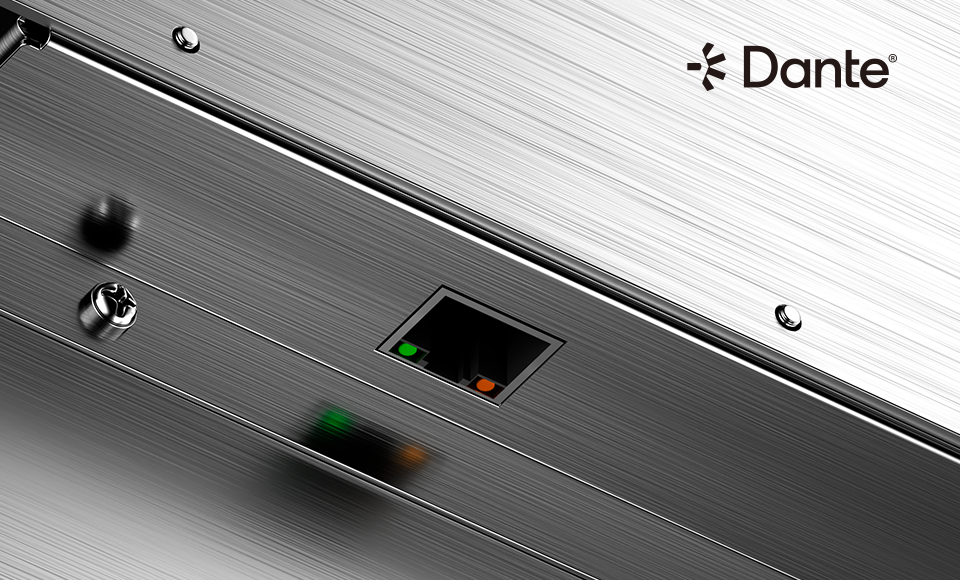
Single RJ45 connection carries PoE power and Dante/AES67 audio (product image: relacart.com)
ACM-582 specifications at a glance
The figures below are taken from the manufacturer’s product page and are worth knowing when you plan a room.
Relacart ACM-582 — key specifications (source: relacart.com product page)
| Item | Specification |
|---|
| Coverage area | 25 × 25 ft (7.6 × 7.6 m), automatic |
| Microphone element | 5 MEMS arrays |
| Frequency response | 100 Hz – 8 kHz (voice band) |
| Dante/AES67 output | 1 channel, 48 kHz, 24-bit |
| Sensitivity (1 kHz) | -1.5 dBFS/Pa |
| Max SPL | 96 dB SPL |
| SNR (ref. 94 dB SPL, 1 kHz) | 75 dB (A-weighted) |
| Self-noise | 22 dB SPL (A-weighted) |
| Dynamic range | 75 dB |
| Latency (excl. Dante) | 48 ms |
| Signal processing | AEC, AI noise reduction, AGC, mute |
| Power | PoE/PoE+ (IEEE 802.3af/at), max 3 W |
| Connection | 1 × RJ45, Cat5e or higher (shielded recommended) |
| Plenum rating / dust | UL2043 / IEC 60529 IP5X |
| Operating temperature | -5 °C to 40 °C |
| Dimensions | 582 × 582 × 51.9 mm |
| Control software | TDM |
Deployment checklist
Before specifying a ceiling array, walk through this list with your integrator:
- Map the room against the coverage area: each unit covers 7.6 × 7.6 m automatically; larger or oddly shaped rooms may need more than one unit.
- Confirm PoE budget on the switch (max 3 W per unit is modest, but count all network devices).
- Run Cat5e or better shielded cable to each microphone position; one cable per unit carries power and audio.
- If the ceiling is an air-handling (plenum) space, the UL2043 plenum rating matters for code compliance.
- Plan a commissioning pass in TDM software: input gain, EQ, high-pass filter, and LED behavior should match the room, not the defaults.
- Check the acoustic treatment basics anyway — AI processing improves what the microphone hears, but it does not replace sensible furniture placement and soft finishes.
Frequently asked questions
How many ceiling microphones does my conference room need?
Start from the coverage figure: one ACM-582 covers a 7.6 × 7.6 m area automatically. A room that fits inside that square can work with a single well-placed unit; larger rooms, L-shaped rooms, or rooms with tiered seating usually need additional units. The final plan should come from an integrator who has seen the room dimensions, ceiling height, and table layout.
Does the ACM-582 work with video conferencing platforms like Zoom or Teams?
The microphone outputs a standard Dante/AES67 audio stream. It connects to the room’s DSP or conferencing codec, which in turn feeds the video platform — the same architecture used by professional conference systems generally. Platform-specific certification is a question for the system designer, not a property of the microphone alone.
Will the panel be visible in the ceiling?
The ACM-582 is an ultra-slim panel (51.9 mm deep) designed for concealed ceiling installation, and it can also be suspended by steel cable or pipe using the optional R-M16 ceiling mount bracket. In a flush installation it sits nearly invisible in the ceiling plane.
What is the latency?
The manufacturer specifies 48 ms of latency excluding Dante network latency. For a discussion system this is inaudible in practice; it is worth including in the total system budget if the room also does live sound reinforcement.
Can one microphone cover a room with high ceilings?
Coverage is specified as a 7.6 × 7.6 m area with automatic behavior; the manufacturer does not publish a maximum mounting height. For rooms with unusually high or sloped ceilings, coverage should be verified with the manufacturer or an experienced integrator before committing to a layout.
Does AI processing remove the need for room acoustic treatment?
No. Processing reduces reverberation, echo, and noise in the captured signal, but extreme rooms (all-glass walls, tall hard volumes) still benefit from basic treatment. The most reliable results come from reasonable acoustics plus good processing, not from processing alone.