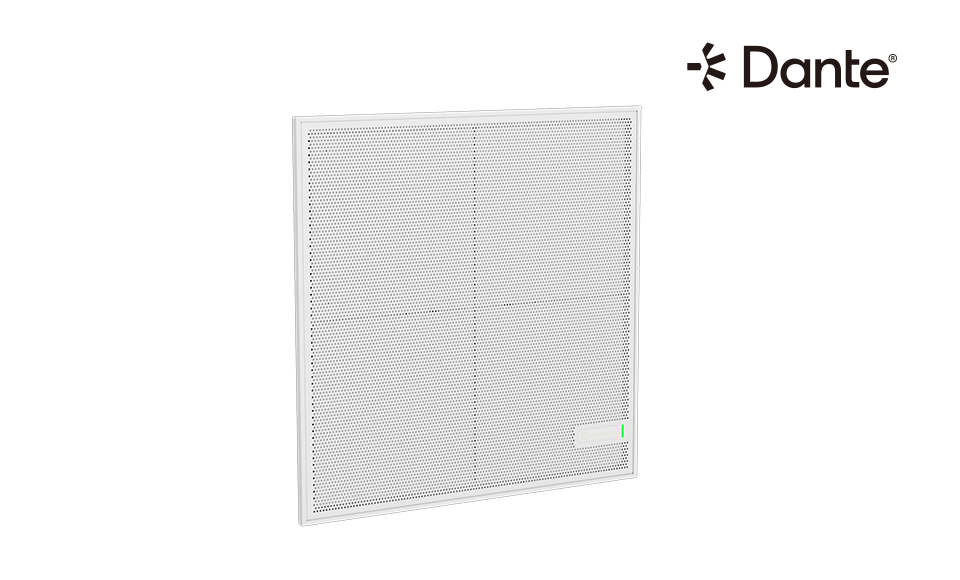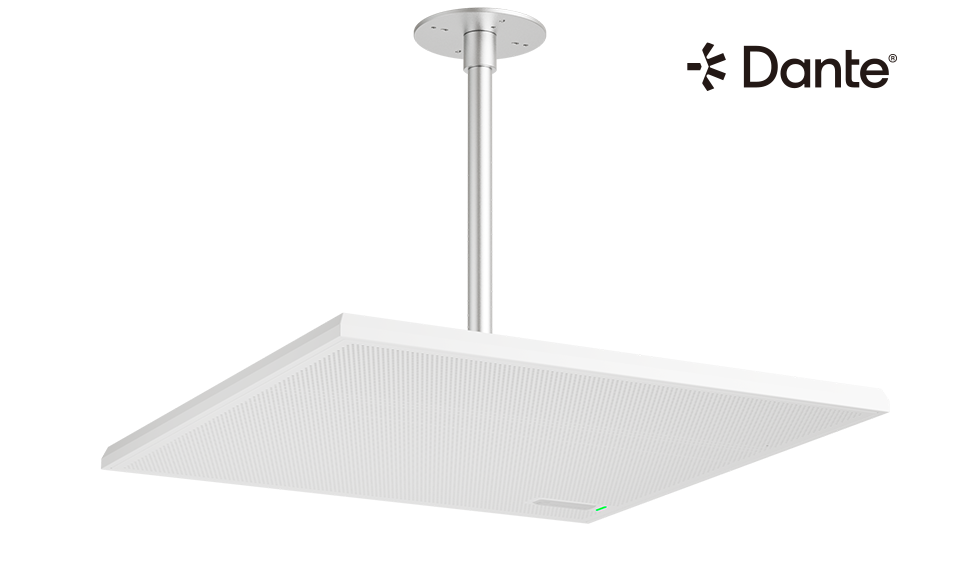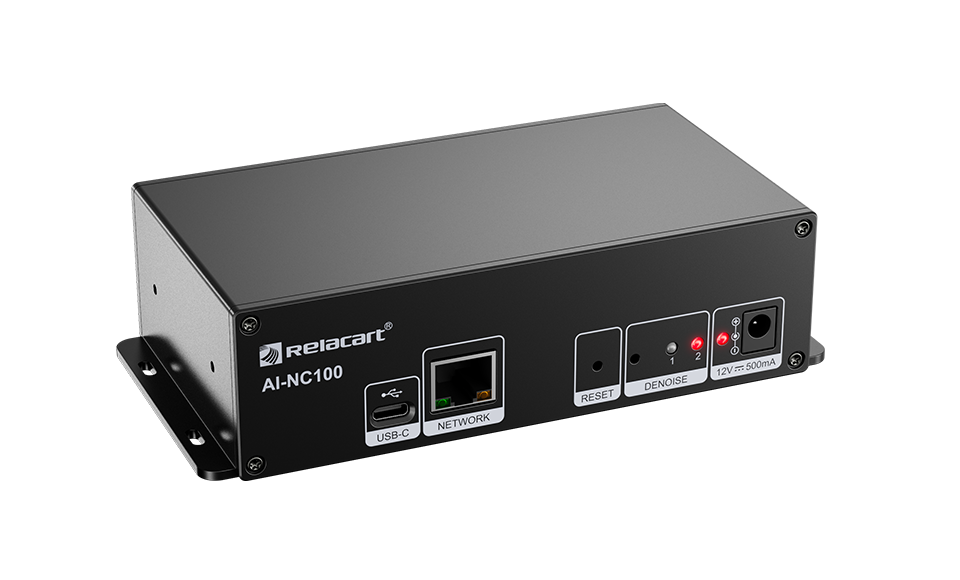
Relacart AI-NC100 AI noise cancelation audio processor (product image: relacart.com)
If a meeting room already has microphones, a mixer, and loudspeakers, the fastest way to improve how it sounds on calls is not to replace everything. It is to place an AI audio processor between the microphones and the console. The Relacart AI-NC100 does exactly that: it takes the signal from an external microphone and applies de-reverberation, acoustic echo cancellation, dynamic feedback suppression, and 360° noise reduction before the audio continues down the chain.
This article explains what the AI-NC100 is, how it connects into a conventional analog system, and which rooms benefit most from adding it.
You do not have to replace the whole system
Thousands of conference rooms, classrooms, and hotel function rooms already have a working analog setup: gooseneck or wireless microphones feeding a mixing console, then an amplifier and loudspeakers. The microphones are fine; the room is the problem. Replacing a working system to fix room acoustics is expensive and disruptive.
The AI-NC100 is built for this case. According to the manufacturer, it optimizes audio captured by external microphones — any type of microphone source, per the operation manual — intelligently reducing noise, eliminating reverberation, and dynamically suppressing feedback. The microphone stays; the signal gets an AI pass on the way to the console.
What it fixes: the same four problems
The AI-NC100 applies the same four AI functions Relacart uses in its ceiling microphone platform, which makes it consistent with rooms where those microphones are already installed.
- 360° AI noise reduction — Removes background noise on both uplink and downlink while preserving voice clarity, so conversations stay natural on both ends of the call.
- Intelligent de-reverberation — Deep neural networks separate direct voice from reflections and improve the Direct-to-Reverberant Ratio — the difference between sounding "in the room" and sounding "far away".
- Full-duplex acoustic echo cancellation — Eliminates echoes even while both parties speak simultaneously, designed for low signal-to-noise environments without special mechanical design.
- Dynamic feedback suppression — The integrated AI processor instantly identifies and suppresses narrowband feedback between speakers and microphones, keeping the system stable and distortion-free.
How it connects into an existing system
The unit is a compact metal box (166 × 83 × 44.6 mm) powered from a 12 V / 500 mA DC adapter. The signal path runs through it as follows: a microphone connects to the input with 0–45 dB of gain available on a panel potentiometer, plus 48 V phantom power that can be switched on or off from software for condenser microphones. A FEEDBACK input accepts the audio signal from a mixer or amplifier output, which is what lets the processor detect and suppress howling loops. The processed audio then goes out to the mixing console or another device input over standard two-core shielded cable. A 1/4" LINE IN (tip-ring-sleeve) is also provided.
On the control side, a USB-C port handles firmware upgrades and data communication, and the NETWORK port connects to a computer for software control — it also supports Dante audio as an option, per the operation manual. A DENOISE toggle switch selects between noise reduction levels (indicators 1 and 2), and the RESET switch restores the network IP address to DHCP mode when held for five seconds.
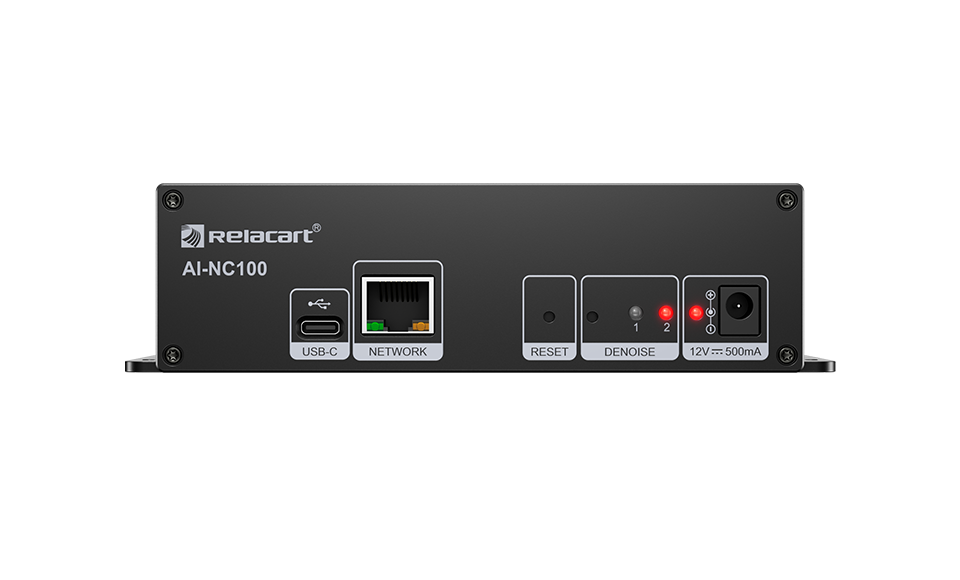
AI-NC100 panel: USB-C, NETWORK, RESET, DENOISE level switch, 12 V power (product image: relacart.com)
Specifications
The figures below come from the manufacturer’s product page.
Relacart AI-NC100 — key specifications (source: relacart.com product page)
| Item | Specification |
|---|
| Frequency response | 20 Hz – 20 kHz |
| Input gain | 0–45 dB (panel adjustable) |
| Input impedance | 3 kΩ |
| Maximum input level | 17 dBu (GAIN at 0 dB) |
| Microphone power | 48 V phantom power (software-switched) |
| Output impedance | 500 Ω |
| Maximum output level | 17 dBu |
| Power supply | DC 12 V / 500 mA |
| Dimensions | 166 × 83 × 44.6 mm |
| AI functions | De-reverberation (DNN), dynamic feedback suppression, full-duplex AEC, 360° noise reduction |
| Control / expansion | USB-C (firmware), NETWORK (software; Dante audio optional) |
Where it fits best
The manufacturer positions the AI-NC100 for conference rooms, classrooms, hotel auditoriums, and business venues, and the operation manual adds concert halls and performance stages. The common thread is a venue that already owns microphones and a sound system but suffers from reflective acoustics, background noise, or feedback — in other words, most real-world rooms.
It is a signal optimizer, not a full DSP replacement. Routing, zone management, and loudspeaker processing remain the mixer’s or DSP’s job. What the AI-NC100 changes is the quality of the voice signal that enters that downstream equipment — which is precisely where room acoustics do their damage.
Deployment checklist
- Insert the processor between the microphone (or microphone group) and the console input; keep cables balanced and shielded.
- Set the input gain with the panel potentiometer (0–45 dB) while talking at normal presentation level.
- Enable 48 V phantom power in software only for condenser microphones that need it.
- Connect the FEEDBACK input from the mixer or amplifier output so the suppression loop can detect howling.
- Choose a DENOISE level (1 or 2) that matches the room — verify with a remote participant on a real call.
- Use the NETWORK port for software control; plan the Dante audio option only if the room’s infrastructure already runs a Dante network.
- Power from the supplied 12 V / 500 mA adapter and keep the USB-C port accessible for firmware updates.
Frequently asked questions
Does the AI-NC100 work with any microphone?
Yes — the operation manual states the microphone input can accept any type of microphone source, with 0–45 dB of gain and optional 48 V phantom power (software-switched) for microphones that require it.
Is it a replacement for a DSP?
No. It optimizes the microphone signal (noise, reverberation, echo, feedback) before the console. Mixing, routing, zone management, and loudspeaker processing remain the job of the mixer or room DSP.
Can it join a Dante network?
The NETWORK port supports Dante audio as an option, in addition to computer software communication, per the operation manual. Confirm the Dante option when ordering.
How is it different from a ceiling microphone like the ACM-582?
The ACM-582 is a microphone with AI processing built in; the AI-NC100 is a processor for microphones you already have. Rooms starting from scratch choose the ceiling platform; rooms keeping their existing microphones add the AI-NC100.
How is it powered and mounted?
It runs from a 12 V / 500 mA DC adapter and, at 166 × 83 × 44.6 mm, occupies little rack or desk space near the console.